
What the Landmark Hudbay Minerals Lawsuits Exposed and Left Unresolved
By Grahame Russell, April 27, 2026
After a 15-year legal battle, Hudbay Minerals was forced in late 2024 to settle with 13 Maya Q'eqchi' plaintiffs from Guatemala in precedent setting civil lawsuits in Canada. In Guatemala, Hudbay's former head of security was forced to plead guilty to murder and aggravated assault in a parallel criminal trial. The “13 Brave Giants’ report tells the full story, including the historical and political contexts and the legal battles in both countries. I recommend reading it.
13 BRAVE GIANTS
How We Won the Landmark Hudbay Minerals Lawsuits in Canada,
the Mynor Padilla Criminal Trial in Guatemala, and at What Cost!
What follows here are issues (set out in the report) that remain unresolved — matters for parliamentary oversight committees in Ottawa, for Canadian prosecutors, and for investigative journalism.
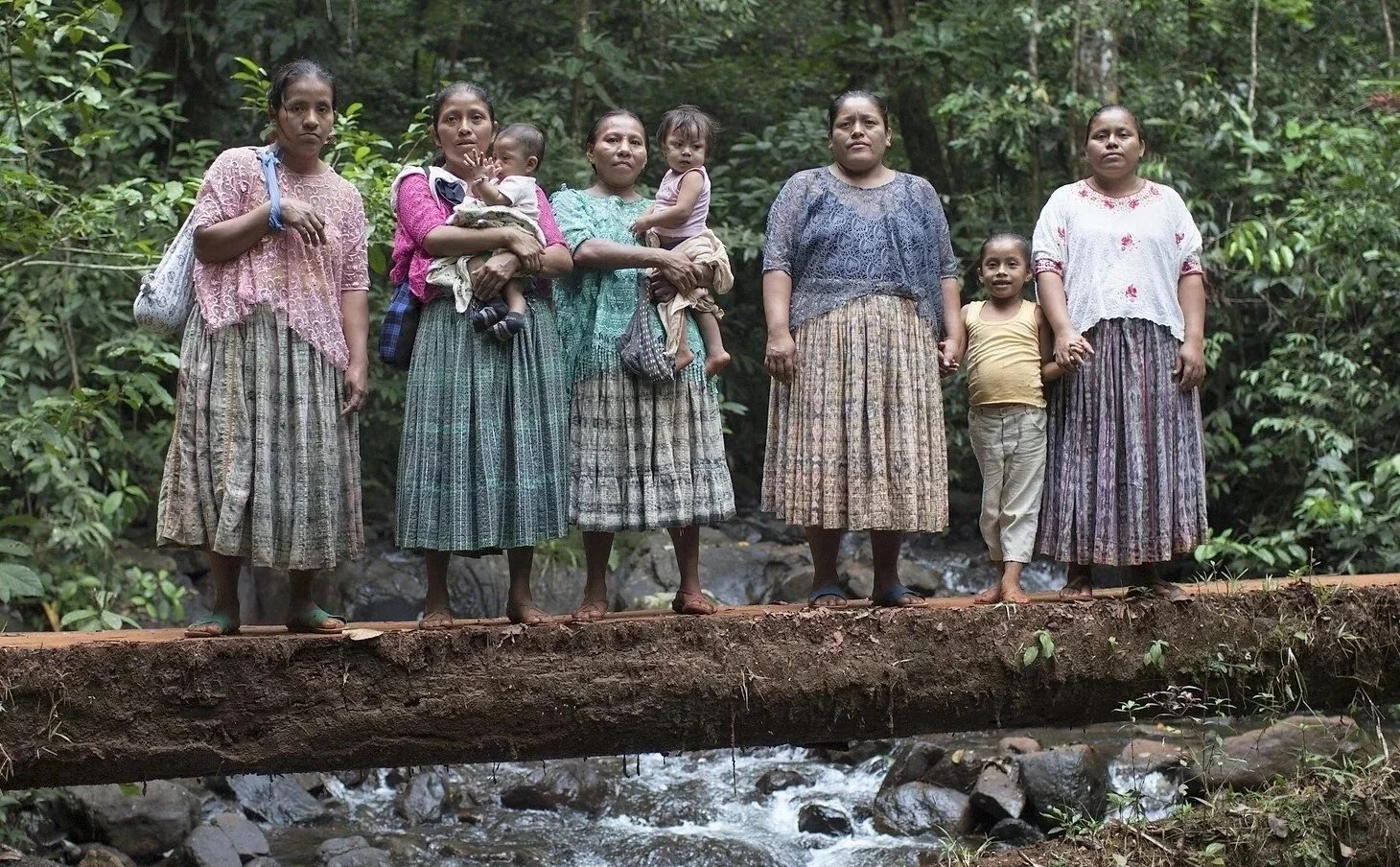
Five of the Lote Ocho plaintiffs. Photo: James Rodiguez
The Origins: INCO and State Violence (1954–1981)
The Fenix mine's history is inseparable from the 1954 U.S.-backed coup and military regimes that followed. Canada established diplomatic relations with those regimes and, soon after, provided political and economic support for INCO's entry into Guatemala. In the 1960s, INCO developed the now notorious Fenix mine on effectively stolen Q'eqchi' lands.
For two decades, INCO operated the mine alongside military regimes that were carrying out disappearances, massacres and genocides (in four specific regions) against mainly Mayan populations.
The Guatemalan Army maintained a military outpost on company property and used INCO's landing strip. INCO personnel and vehicles transported soldiers through the Q'eqchi' region while they committed acts of repression — facts documented in the 1999 UN Truth Commission report.
INCO personnel and company vehicles allegedly played a role in the May 29, 1978 Panzós massacre, in which some 140 Q'eqchi' villagers were slaughtered 30 minutes from the mine's processing plant.
Both the Canadian government and INCO would hold extensive records from this period. None of these issues have been examined. Had there been accountability for any of this — in Ottawa, in Canadian courts — it is unlikely that Skye Resources and Hudbay Minerals could have moved into Guatemala in the 2000s and operated as they did.
The Repeat: Skye Resources, Hudbay, and the Fenix Mine (2004–2011)
In the early 2000s, former INCO directors incorporated Skye Resources to then restart the mothballed mine operation in 2004. Skye was amalgamated into Hudbay in 2008.
Between 2004 and 2011, the Canadian government turned a blind eye to, and even lied about human rights violations linked to the mining operation.
The company contracted security forces — including Mynor Padilla's — that were never legally registered. The UN-backed International Commission Against Impunity in Guatemala (CICIG) classified them as illegal, clandestine organizations.
In January 2007, these security forces, together with Guatemalan soldiers and police, carried out the forced eviction of the village of Lote Ocho — burning it to the ground. During the operation, 11 women villagers were gang-raped by roving company security forces, soldiers and police. Whether this was a deliberate strategy of community terrorization has never been investigated. These women became 11 plaintiffs in the lawsuits in Canada.
As revealed in the lawsuits, during this time period the company made non-invoiced, non-contracted cash payments to military and police for their planning of and participation in the forced evictions, flew increasingly low helicopter runs over villages to terrorize residents into leaving (a tactic consciously borrowed from the army's conduct during the genocide years), and maintained an explicit policy of stalling legal processes and refusing any negotiation with Q’eqchi’ communities related to the underlying, unresolved land claims issues.
None of this was ever properly investigated, even by Canadian prosecutors for possible violations of criminal law addressing corruption of foreign public officials.
In September 2009, German Chub - a young campesino farmer - was shot and left-paralyzed by Mynor Padilla. That same day, Adolfo Ich — a teacher, land and rights defender — was killed by Padilla. German and Angelica Choc, the widow of Adolfo, joined the 11 women from Lote Ocho as plaintiffs in the lawsuits.
Whether the killing of Adolfo was premeditated and targeted, rather than a spontaneous act, has never been properly examined. As revealed in the criminal trial, Kaibiles Special Forces soldiers were present and collaborating with company personnel before, during and after the killing of Adolfo. So irregular was this that the Guatemalan Attorney General opened a criminal investigation into this military–corporate collaboration; it was shelved during the corrupt administration of President Morales (2016–2020) and has not been reopened.
The Legal Struggles and Their Shadows (2010–2024)
What most commentary on the Hudbay lawsuits misses is how the Canadian civil cases and the Guatemalan criminal trial were deeply entangled. Of the 13 plaintiffs, two - Angelica and German - were also witnesses and participants in the criminal trial against Mynor Padilla for murder and aggravated assault.
It is widely understood that Hudbay paid for Padilla's entire defense; there are clear indications that Hudbay and its lawyers in Canada and Guatemala were playing each legal process against the other. At the end of the day, this only served to drag both legal processes on for years, increasing the suffering and risks of violence to the plaintiffs.
Soon after the killing of Adolfo and shooting of German, an arrest warrant was issued in Guatemala for Padilla. The civil lawsuits were filed in Canada in late 2010 and early 2011. Yet Padilla continued to work openly as head of security on the company payroll for years after the arrest warrant was issued. It was never investigated whether Hudbay and its subsidiary company CGN played a role in helping Padilla evade arrest.
The character of Padilla's defense team raises many questions. One lawyer, Francisco Palomo, was assassinated mid-trial in 2015 in a daytime, drive-by shooting in Guatemala City — an act later linked to his work for a major drug trafficker. A second, Frank Trujillo, was charged in 2016 with bribery, influence trafficking, obstruction of justice and collusion in a corruption ring that brought down a former President and Vice President. Who Hudbay was paying, and what they knew about these individuals, remains unexamined.
The trial court judge who acquitted Padilla of all charges in April 2017 delivered a ruling so compromised that an appeals court overturned it and ordered a full retrial. Pursuant to the compromised ruling, the Guatemalan Supreme Court of Justice ruled in 2018 to lift the judge’s immunity from legal liability so as to investigate whether she committed a crime in the rendering of her acquittal decision. This criminal investigation was also shelved during the Morales administration.
In the middle of the two legal battles, Angelica Choc's home was shot up in September 2016 while she slept inside with her two youngest children. In March 2018, Angelica’s nephew's beaten body was found dead at the edge of the town of El Estor. Police investigations into both incidents were opened, then shelved. These violent acts against a plaintiff in the lawsuits and witness in the trial were never properly examined.
In 2020, the underlying land claims issues came to the fore again when the Guatemalan Constitutional Court ruled that the original mining license granted to Skye in 2004 should never have been granted. It has never been examined properly that while the companies were conducting violent evictions, rapes, violence and killing, they didn’t even have the right to be there.
What Remains
These are not historical curiosities. The INCO records exist. The Hudbay and CGN records exist. The shelved investigations in Guatemala can possibly be reopened. The Canadian government's role — from 1954 through the 2000s — has never faced parliamentary scrutiny.
The patterns of government-corporate-military behavior are consistent across six decades of the Fenix mine: a Canadian company operates alongside state violence in Guatemala, Canada looks the other way, and no one in Ottawa is ever called to account.
The settlement ended these precedent-setting lawsuits. It did not close these questions.
*******
Please share and re-post this information
*******
Podcast: Blueprints of Disruption interview with Grahame Russell
Canadian mining imperialism, Hudbay Minerals lawsuits & Guatemala's 13 Brave Giants
Rights Action archive: https://rightsaction.org/hudbay-minerals-lawsuits
More information
Grahame Russell, info@rightsaction.org
Cory Wanless, cory@phillipsbarristers.ca
Murray Klippenstein, murray.klippenstein@klippensteins.ca