
Ben Linder Presente! International solidarity & struggle to end imperialism
Remembering Ben Linder, murdered by U.S.-Contras in Nicaragua;
Honoring Brian Willson in defense of Nicaragua
Rights Action shares a reflection by James Phillips and a statement by Brian Willson, summarized in the April 30, 2026 NicaNotes, by Nan McCurdy.
On the 39th Anniversary of His Death: Ben Linder Presente!
By James Phillips
(James Phillips is a cultural anthropologist. He and his wife Lucy Edwards were Witness for Peace team members in Nicaragua in 1985-87.)
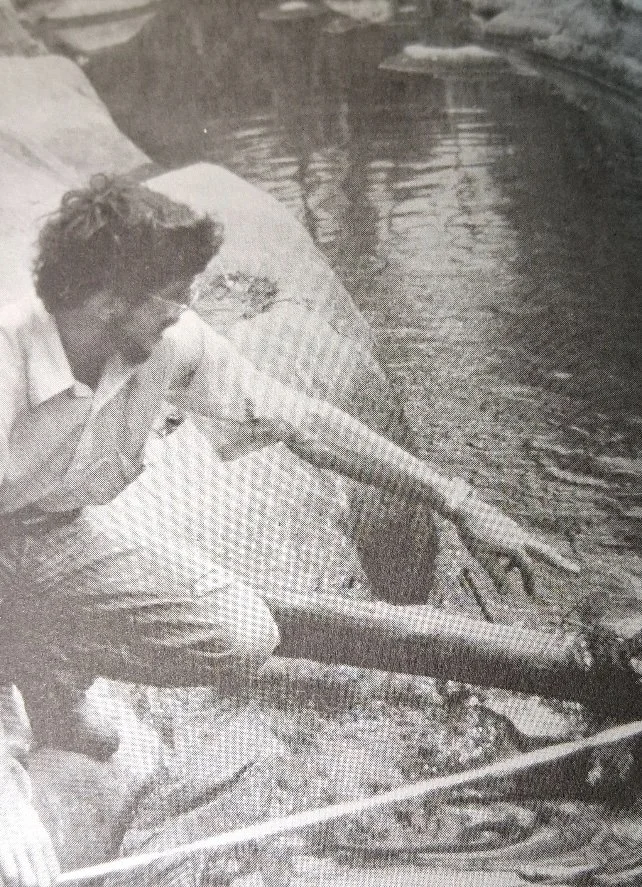
“What he wanted to do was to bring hydro power to remote areas in the country so they could become self-sufficient, proud, productive people.” Ben’s father, David Linder, testifying before a US House of Representatives committee. (Photo: Mira Brown from The Death of Ben Linder)
The life and death of Ben Linder have become emblematic of what international solidarity meant during the contra war. Linder was born in San Francisco in 1959. His parents were refugees from eastern Europe. The family moved to Portland, Oregon, when Linder was eleven. He received a Bachelor’s Degree in mechanical engineering in 1983 and spent time in Costa Rica learning Spanish in preparation for going to Nicaragua “to seek his fortune,” as his father said after Ben’s death.
In Nicaragua, Linder was hired by the National Energy Institute and eventually sent to work on a hydropower project in the remote region of El Cua and San José de Bocay in the north. The area had no electricity.
In December, 1986, Linder left the Institute to work on developing other hydroelectric projects in the same region. The region was considered dangerous. There were frequent contra attacks in the area in early 1987. In March, as many as four hundred contras attacked the nearby agricultural settlement of El Cedro, killing several people and destroying a medical clinic.
It was the third such attack on the community. On March 24, contras attacked a hydroelectric power unit that Linder himself had designed and helped construct. They were repelled by a detachment of Sandinista Army soldiers.
During the last week of April, Linder and six local Nicaraguans were working for several days to complete a small hydroelectric project. On the fourth day, Linder went back with several workers to test the water flow before the onset of the rainy season in May. They arrived at 8 a.m. At about 8:30 at least ten contra soldiers attacked the group, throwing a grenade that immobilized Linder and two Nicaraguan workers. Contras then stabbed one to death and shot the other in the ear, killing him. Linder had shrapnel in his leg. The contras shot him in the head.
This version of what happened was later confirmed by forensic examination of the bodies, and it contradicted other versions of events put out by the Reagan Administration and the contras: that Linder and the Nicaraguans were killed in a battle with a contra unit that accidentally found them; or that a contra unit saw the group in military uniforms and armed, and mistook them for Sandinista soldiers; or even that Linder and the others were caught in a crossfire between contra and Sandinista Army soldiers.
Ben Linder’s funeral was held in Matagalpa on May 1, 1987. It was attended by hundreds from the area and from other parts of Nicaragua, and a large contingent of international volunteers including Lucy and me and other WFP team members.
President Daniel Ortega and Linder’s parents David and Elizabeth led the procession to the cemetery. The silence of the solemn march was broken occasionally by shouts of determination from Sandinista youth groups and others.
In testimony before the Sub-Committee on Western Hemisphere Affairs of the U.S. House of Representatives in Washington a few weeks after the funeral, his father David spoke about Ben’s motivation:
“He had a firm commitment to develop [electricity] units up there [El Cua] which were independent from the main city so that you did not have to go four to six hours to get there, a unit which would have its own hydroelectric power, and from that power there would be development of a machine shop, a wood mill, and a rice processing facility, along with a school, a medical clinic, and the like. It was his attempt to empower people in the area, to give them control over their own lives in the most real sense of the word. This was his idea of the revolution. This was how he expressed what he wanted to do to further the cause of Nicaragua. It was what he did, not what he said. And what he wanted to do was to bring hydro power to this–to remote areas in the country so they could become self-sufficient, proud, productive people.”
It is worth noting that the Reagan Administration tried to present an alternative narrative of Linder’s killing that shifted the blame to Linder himself or to the Sandinista Army. It was part of a larger campaign to discredit international solidarity with revolutionary Nicaragua. The falsehoods and propaganda continue in other forms today, but the memory, example, and spirit of Linder’s solidarity remain strong. Ben Linder presente!
NicaNotes, by Nan McCurdy
April 30, 2026
National Assembly Approves “Internationalist Heroes Day”
On April 24, the National Assembly of Nicaragua issued a press release announcing that it had approved a law designating April 28 as “Internationalist Heroes Day,” in recognition of brothers and sisters among the peoples of the world who embraced Nicaragua’s struggles for peace, truth, and justice with a spirit of solidarity and revolutionary commitment. April 28 is designated as Internationalist Heroes’ Day “in honor of all the internationalist heroes who sowed hope, solidarity, unity, and total dedication, serving as a powerful beacon that guides us … immortalizing themselves in an eternal spring of peace and goodness.”
“We establish this date by taking as our historical reference April 28, 1987, the day when our brother Benjamin Linder was assassinated in El Cuá,” Deputy and National Assembly president Gustavo Porras said. “Ben’s work and sacrifice symbolize the dedication and commitment of internationalist brothers and sisters who have given their lives for our people. Every April 28, in every municipality, we will honor the internationalist heroes and heroines who made our homeland their cause, their commitment, and their hope, giving themselves generously in every place where life, dignity, and the revolution flourished.”
Brian Willson Leads Ceremony to Celebrate “Internationalist Heroes Day”
(On September 1, 1987, while protesting the shipping of U.S. weapons to Central America, including U.S.-Contra war against Nicaragua, Brian Willson and other members of Veterans for Peace blocked railroad tracks at the Concord, California, Naval Weapons Station. An approaching train did not stop, and struck the veterans. Willson was hit, ultimately losing both legs below the knee while suffering a severe skull fracture with loss of his right frontal lobe.)
On April 28, internationalist hero Brian Willson, spoke at a special session of the National Assembly of Nicaragua, explaining how the struggle of the Nicaraguan people and their Sandinista Popular Revolution changed his life. During the special session marking the new Internationalist Heroes Day, the Assembly honored Hero of Solidarity Brian Wilson as a symbol of courage, heroism, and solidarity.
“Since my participation in the Vietnam War, when I realized that the United States’ imperialism [hurt and killed] innocent peoples and individuals, I lost my fear of being afraid. I thank Nicaragua and its Revolution for changing my life; the people who fought are the true heroes,” Wilson stated.
Dr. Gustavo Porras, on behalf of the Sandinista Government and the people of Nicaragua, thanked him for his solidarity and sacrifice for the Nicaraguan people. He went on to say, “Nicaragua is celebrating “Internationalist Heroes Day” for the first time to honor the legacy of men and women from around the world who contributed to the struggle of the Nicaraguan people. The date chosen for this commemoration is no coincidence: on April 28, 1987, Benjamin Linder—an internationalist who stood in solidarity with the Revolution and the Nicaraguan people—was assassinated by the counterrevolution. Linder gave his life while working on rural projects, [small hydroelectric dams to bring light to villages], and became the eternal symbol of that group of men and women who, from different parts of the world, have offered their selfless love to Nicaragua.”
Wilson told the Assembly,
“I was drafted to go to the Vietnam War as a member of the U.S. Army. And I had no particular political views. I had no aspirations, no political leanings, and I had no choice but to go and participate in the Vietnam War.
“Something happened to me during the first two months I was in the Vietnam War. I was in a village and my assignment at that time was to ensure the success of our mission. It never occurred to me that the main goal was [to kill] the people living in those small villages. My ignorance—I was completely unaware of the interests and ideology instilled in me by the United States Army.
“I had a Vietnamese guide. When I was driving my Jeep, he helped me enter the first village. It hit me hard to see how they bombed that village and to come across so many dead and so many people who were nearly dead. I walked as far as I could; there were so many dead, so many bodies, that I reached a point where I couldn’t go any further, because there were so many bodies that there was no other way to continue. At my feet was a Vietnamese woman hugging three children … What struck me was that the woman holding her three children had her eyes open. Open! And I could see that—what struck me most—was that she had no eyelashes; all her eyelashes were burned off. And I imagine she was trying to flee; she had been running for hours with her children, trying to save herself, but with those bombs, there was no way.
“It was essential for me to understand that our military objective was to bomb these villages, these communities of fishermen and farmers. I was crying and didn’t know why, and what could I do?! What should I do?! I was in shock.
“And the Vietnamese guide asked me, “Why are you crying?” I was in shock—partly because of the question he asked me—I was disoriented, I was in shock; I was in a whirlwind of emotions. And it was at that moment that I felt a bolt of lightning—it struck me—seeing that woman’s eyes. I felt like I was looking into my sister’s eyes.
“And it was the first time I understood that we are all one people. We are all human beings, sisters and brothers of this planet. Because before that moment, I—who come from the lower class, economically speaking, from a town in the United States, [a country that] has a mindset that considers itself superior to others. So, in that moment, I felt something. I wasn’t the peace activist—the kind so many of us now identify as, seeking peace and calling ourselves peace activists. Understanding the world I come from—the United States—and the ideology that tells us that we are superior beings was a profound revelation. And for the first time, I understood what it means to seek peace in the world. From that moment on, my life has never been the same. And when I returned from the war, I began to study Native Americans. I wanted to understand what really happened in the history of the United States.
“As I studied, I realized that we haven’t been taught the true history of the United States. The true history is that we, driven by our self-centered ideology, have murdered the Indigenous Peoples, who are the original inhabitants of the United States. And it wasn’t just Native Americans, but also people of African descent, who were brought to the US as slaves to enrich a few white people.
“So, in 1986, I decided to come to Nicaragua to study the war but also to educate myself because I realized I had been ideologically brainwashed. The perception I had wasn’t the true one in world history. I studied in Estelí, and the first week I arrived the counterrevolution attacked three communities, three families, and murdered eleven people. And this moved me deeply because I couldn’t believe I was reliving what I had experienced in the Vietnam War. Seeing the same system being implemented against these families, in these small towns of Estelí, which were treated as military targets. Very innocent people and families—it was so disgusting to me; I was deeply moved.
“Later that same year, 1986, I returned to my community and met with fellow anti-war veterans. Three of them had served with me in Vietnam, and there were four others. We decided to join the protest against Reagan’s terrorist campaign against Nicaragua—the one President Reagan was waging against Nicaragua—and that is how we began our protests.
“We were preparing to join this great cause, knowing we had no hope in the United States. And with that spirit of fighting for Nicaragua’s freedom, we joined forces with other protesters from Great Britain. During that time of preparation, I lost my fear of death. Knowing we had to confront Reagan, we had to protest. During the protest, which was a hunger strike, we were there for 47 days, consuming only water. The doctors who were treating us approached us and told us, informed us that one of the veterans was on the verge of dying from dehydration. So, at the end of that 47th day, we started eating again, but we also realized that the FBI had labeled us as domestic terrorists. It was yet another experience that taught us just how malicious and sick the United States had become. President Reagan’s policies at the time were atrocious. So, we returned to Nicaragua for six months.
“These are some of the experiences that led me and other comrades or veteran comrades to block the ammunition going on trains from the United States to Nicaragua. At that time, once again, it was confirmed that the FBI had us marked as domestic terrorists, and that the trains were carrying ammunition, and that it was the FBI that gave the order not to stop the train with the ammunition.
“I believe that all of us, as human beings, should feel the same way about others. It’s a miracle that I’m here, that I survived. So, it was a miracle for me, because where I come from—that small town where I grew up, a very religious little town—I’ve now become an activist, a peace activist, and then a lawyer. For me, this isn’t heroic; for me, it’s a duty: empathy, solidarity, and understanding people. For me, the people of Nicaragua are heroic, just like the people of Vietnam. These two peoples are the ones who inspired me to fight against imperialism.
“I cannot thank the Nicaraguan people enough; I thank them for the Nicaraguan Revolution. It was a starting point for me in my struggle. It was a starting point for my people to understand what the United States and the imperialist system were doing against these peoples. I had no idea that today was going to be such a special session for the Heroes and the Nicaraguan people. For me, I came here as just another guest at a session of the National Assembly. So, I’m also in shock at everything that’s happening and that I’m the guest of honor. Thank you so much, Nicaragua! I’m so grateful to you all!” (La Primerisima, 28 April, 2026)