
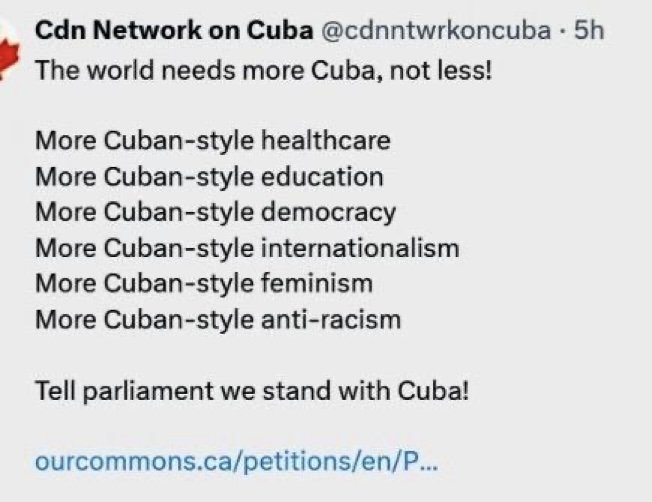
The world needs more Cuba, not less
Below:
Article by Owe Schalk: “Canadians must support Cuba against Trump’s barbaric siege”
Statement on X by El Necio, a young man in Cuba
“The explicit goal of administration officials and the extreme-right Cuban American diaspora is to sow misery on the island—to create hunger, medicine shortages, and energy blackouts.”
“There is a real risk that the rolling blackouts that have menaced the island for years will worsen, plunging Cuba into indefinite darkness and making it impossible for hospitals, farms, electrical systems, transportation, educational institutions, and other essential services to function.”
Rights Action encourages folks to get involved to pressure the government of the U.S. to end its 64-year economic warfare campaign against Cuba.
It is clear to us that what the U.S., and the West by complicit extension, are interested in Cuba is to put in power “open for global business” economic elites not unlike the traditional elites long in power in Honduras and Guatemala.
When Honduras tried to change direction from 2022-2026, and break the iron-clad control of these traditional elites and their Western allies, the U.S. orchestrated an electoral ‘regime change’ coup in late 2025 to bring back to power the corrupt, repressive traditional elites.
Since 2023, Guatemala has been similarly trying to break from the iron-clad control of its traditional elites, and their Western powers allies. The corrupt, violent attacks of those elites will only increase in 2026-2027 as they try to re-assert their domination over the country.
Canadians must support Cuba against Trump’s barbaric siege
With the US tightening its grip, Canadians must step up where their government won’t
By Owen Schalk / February 10, 2026
https://canadiandimension.com/articles/view/canadians-must-support-cuba-against-trumps-barbaric-siege
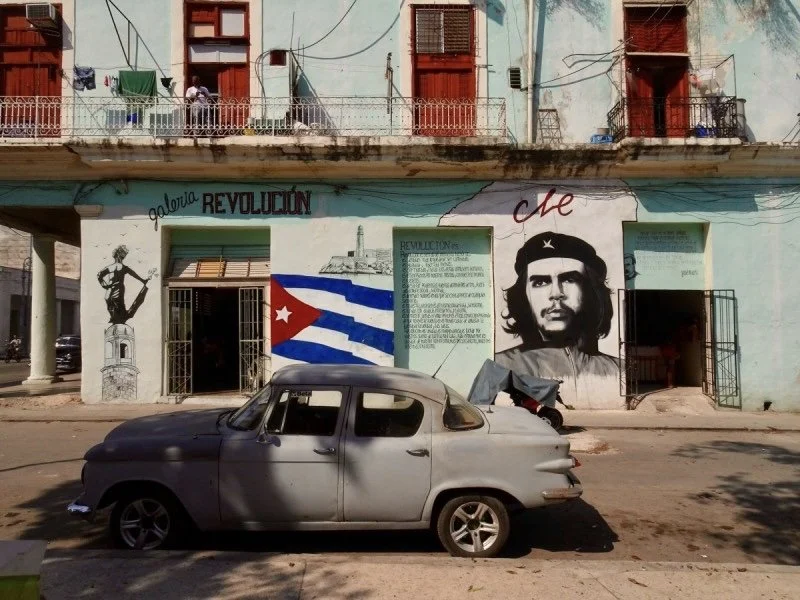
Havana, Cuba in 2023. Photo by Bruno Rijsman/Flickr.
_-_68.jpg)
The Cuban Revolution is facing perhaps the most difficult moment in its history.
US President Donald Trump has openly declared his aim to overthrow the Cuban government by year’s end. To secure this goal, Washington is tightening its 60-year blockade of Cuba into a veritable siege. The Trump administration has labelled the small, peaceful Caribbean nation an “unusual and extraordinary threat” to the United States and weaponized tariffs against any country selling oil to Cuba.
The US invasion of Venezuela, and Trump’s successful pressure campaign against Mexico’s state oil company, PEMEX, have severed Cuba from its main energy suppliers. In a single month, 77 percent of Cuba’s oil imports have vanished. The 10 percent Cuba receives from Russia, along with tiny humanitarian shipments from Mexico, cannot fill the gap.
The explicit goal of administration officials and the extreme-right Cuban American diaspora is to sow misery on the island—to create hunger, medicine shortages, and energy blackouts. When Florida Representative Carlos Gimenez threatened Cuba, an island of nearly 11 million people, with “no oil, no travel, no oxygen,” the mask didn’t just slip—it shattered. Representative Maria Elvira Salazar, also from Florida, admitted that the US siege is depriving Cubans of food and medical care, and stated that she supports this sadistic policy if it means “free[ing] Cuba forever.”
US intentions toward Cuba are clearer than ever. Washington wants to strangle an entire nation into submission.
On January 31, the Canadian Network on Cuba (CNC) issued a statement condemning Trump’s latest aggression against the island:
“This reprehensible, illegal, and immoral action constitutes a direct and blatant attack on the Cuban people and is an escalation of decades of economic asphyxiation and sabotage… The US government has never shied away from economic terrorism in its plans to reconquer Cuba, but the severity of this new strategy threatens the Cuban people with annihilation.”
Isaac Saney is a member of the CNC’s executive committee, and a Black Studies and Cuba specialist at Dalhousie University. In an interview with Canadian Dimension, Saney stressed that “the Cubans have always been incredibly resilient.” He added that “this is perhaps the most dangerous time that the Cuban Revolution has ever confronted. And this is obviously the greatest challenge that the Cuba solidarity movement has faced.”
Long burdened by US-imposed shortages, Cuba has now entered a new era of deprivation. At the end of January, reports circulated that Cuba had only 15 to 20 days of oil left. There is a real risk that the rolling blackouts that have menaced the island for years will worsen, plunging Cuba into indefinite darkness and making it impossible for hospitals, farms, electrical systems, transportation, educational institutions, and other essential services to function.
Following last month’s imposition of an illegal oil blockade, Trump said, “The Cubans have complained for years about ‘the blockade.’ But now there is going to be a real blockade.”
In fact, the blockade has been very real—and ruthless—for more than six decades. For 33 consecutive years, an overwhelming majority of countries at the UN General Assembly have voted to condemn Washington’s illegal, unilateral policy of economic strangulation against Cuba.
The infamous Mallory memorandum of April 1960, written by US Deputy Assistant Secretary of State for Inter-American Affairs Lester Mallory, exposed Washington’s efforts to impose economic hardship on Cuba almost immediately after the Fidel Castro government took power in 1959. The memo acknowledges that “the majority of Cubans support Castro (the lowest estimate I have seen is 50 percent).”
Mallory concluded that “the only foreseeable means of alienating internal support is through disenchantment and disaffection based on economic dissatisfaction and hardship… it follows that every possible means should be undertaken promptly to weaken the economic life of Cuba.”
What means did Mallory recommend? “[D]enying money and supplies to Cuba, to decrease monetary and real wages, to bring about hunger, desperation, and overthrow of government.”
According to Cuba’s government, the US blockade has cost the island roughly $150 billion USD. Each subsequent measure to tighten the blockade—the Helms-Burton Act of 1996, and the absurd “state sponsor of terrorism” designations of 2021 and 2025—has intensified the collective punishment of the Cuban population.
In November 2025, UN Special Rapporteur on Sanctions Alena Douhan visited Cuba to assess the impact of the blockade. Douhan found that unilateral US sanctions were “suffocating the social fabric of Cuban society,” and that the blockade had “severe consequences for the enjoyment of human rights, including the rights to life, food, health and development.” She further reported “shortages of food, medicine, electricity, water, essential machinery and spare parts… while a growing emigration of skilled workers, including medical staff, engineers and teachers, is further straining the country.”
Yet according to Trump, there had been no “real” blockade of Cuba until last month.
While enduring more than 60 years of brutal US attacks, Cubans have managed to build one of the world’s most advanced health care systems, while providing universal housing and education. The blockade has never crushed Cuba’s internationalist spirit.
In the 1970s and ’80s, Cuban fighters played a central role in liberating Africa from apartheid. To this day, Cuba’s medical internationalism is renowned worldwide, with tens of thousands of Cuban doctors providing vital health care services across the globe. During the COVID-19 pandemic, the Cuban government sent medical professionals to Italy, which was hit hard by the virus. In February 2025, Barbadian Prime Minister Mia Mottley said, “We could not get through the pandemic without the Cuban nurses and the Cuban doctors.” Grenada’s prime minister was even more direct: “I do not believe that any public health system in the Caribbean can survive without the support of the medical personnel from Cuba.”
Canadians should also recall that in 2020, Manitoba First Nations requested that Ottawa allow Cuban doctors onto reserves to protect Indigenous peoples from COVID-19. The Trudeau government refused. Had Ottawa accepted, Cuban doctors would have been more than willing to fly to Manitoba and provide high-quality medical care for Indigenous communities.
Given Cuba’s global generosity, the Canadian government’s non-response to Trump’s latest escalations is shameful. Neither Prime Minister Mark Carney nor Global Affairs Canada has condemned Trump’s efforts to accelerate Cuban suffering and push the country toward collapse. According to two former Canadian ambassadors to Cuba, Canada’s response—or lack thereof—to US aggression is shaped by “Ottawa’s need to secure a renewed trade deal with the US.”
While Cuba has consistently shared its limited resources with the world despite decades of US sabotage, the Canadian government is unwilling to risk even the mildest rebuke from Washington by standing up for international law and the human rights of Cubans.
Mark Carney’s hypocrisy is glaring. He won the April 2025 federal election while vowing to stand up to Trump and defend the principles of national sovereignty and territorial integrity. Last month at the World Economic Forum in Davos, Carney declared that Canada has “the capacity to build a new order that encompasses our values, such as respect for human rights, sustainable development, solidarity, sovereignty, and territorial integrity of the various states.”
Now, as the US campaign against Cuba tramples all of these principles, Carney refuses to say a word—just as he refused to condemn Trump’s illegal and unprovoked aggression against Venezuela on January 3.
Saney emphasizes that, despite the US siege, Cuba is not entirely isolated. China just sent them $80 million to upgrade the electrical grid, as well as 60,000 tons of rice. They’ve received assistance from Vietnam. There’s also the economic relationship between Cuba and Canada. Cuban tourism has taken a very significant blow because of US threats and aggression, but Canada continues to be one of the largest sources of tourists to Cuba, as well as foreign investment. BRICS countries have condemned the US attack.
Why should Canadians show solidarity with Cuba? Saney offers two reasons: moral and ethical obligation, and national self-interest.
“The United States is inflicting collective punishment on a country that refuses to bend to the US will,” says Saney. “Countries have a fundamental right to self-determination. They should be able to determine their economic, political, and social systems without external interference and coercion.”
He adds that Canada also has a direct interest in defending Cuba from US attack. “The US has targeted Canada’s right to self-determination, independence, and sovereignty as well. So in defending Cuba’s self-determination, independence, and sovereignty, we are also defending Canada’s.”
Canada’s government refuses to stand up for Cuba, but Canadians at the grassroots can. We can support the campaigns of national solidarity organizations like the Canadian Network on Cuba. We can join regional solidarity committees in our cities. We can donate to fundraisers, petition Parliament, and travel to the island on work brigades or as tourists.
Time is running out. There has never been a greater need for Canadians to show solidarity with Cuba—to demonstrate respect for the resilience and independence of the Cuban people, and appreciation for decades of Cuban generosity.
If Cubans can share what little they have with the world, Canadians can share some of our own resources with the people of Cuba when they need it most.
(Owen Schalk is the author of Targeting Libya: How Canada went from building public works to bombing an oil-rich country and creating chaos for its citizens, an exploration of Canada’s pivotal yet little-known role in Libya’s history, now available from Lorimer Books.)
El Necio
@ElNecio_Cuba
Dec 20, 2024
I am Cuban. I live in Cuba. I experience daily power outages and shortages of all kinds. It's real. But I also know the fundamental cause of this: the ECONOMIC REPRESSION by the US to wear down my people and make them surrender their independence, which they fought for over almost 100 years of various struggles.
Do you think that's not the case? Look... from 2014 to 2019 (the Obama era) we had a period of stability: there were no power outages, no inflation, food, goods, and services were affordable, and both the private and state sectors were developing.
And they didn't even lift the blockade, just some sanctions, and they removed us from an unfair “list of state sponsors of terrorism,” which we were put back on in 2020, in the middle of the pandemic. Just with that crack, everything was different.
If the blockade already limits us, that list prevents us from trading; no one wants to trade with a country on that list, or accept common transactions or payments...
Today, the country is not doing well. That is the truth. But we are not going to give up our struggle because that is what they want: to bring Cuba down so they can go after other peoples.
But seriously: imagine what my country would be like without that blockade, without that persecution, without that brutal economic war: an example in terms of living standards and social progress that they want to avoid at all costs, because of the envy it might cause.
Even so, there are those who look at us and feel proud: because in the midst of all this that hurts us so much, we have managed to develop indicators in terms of health, education, social security, scientific research, access to culture, and world-class sporting achievements. But we want to do more: we want them to let us live and be happy, so that no other Cuban has to emigrate. Every year, at the UN, the whole world supports us because they know how much Cuba has to offer and how unfairly we are being treated.
Thank you for reading. I send you my best wishes for the end of the year.
In Canada, please follow the work of:
Canada Network on Cuba
https://canadiannetworkoncuba.ca/
@cdnntwrkoncuba
---
Change media sources
Rights Action urges folks to diversify their news sources as an antidote to the oftentimes misleading reporting coming from much of the government and corporate media in the U.S. and Canada. We recommend The Gray Zone, Democracy Now, DropSite News, The Real News Network, CounterPunch, The Intercept, Canadian Foreign Policy Institute, The Breach, rabble.ca, Orinoco Tribune, Al Jazeera News (coverage of Palestine), …