
Controversial Aura Minerals pushing to open rejected gold mine in Guatemala
As “Pact of the Corrupt” continues with strangle hold on corrupted legal system
Below: Prensa Comunitaria article, February 6, 2026
From 2013-2021, Rights Action supported and took human rights delegations to visit a courageous community defense struggle in Azacualpa, Honduras where Aura Minerals, a U.S.-based, Toronto-listed company, operated an open-pit, cyanide leaching gold mine, that including illegally digging up and destroying a 200 year-old community cemetery.
This struggle was taking place during the years (2009-2022) of the U.S. and Canadian-backed, corrupt and repressive narco-regime head by disgraced former President Juan Orlando Hernandez.
Now, Aura Minerals has swooped in and purchased ill-gotten licenses to the Cerro Blanco gold mine in Guatemala, renaming it the “Golden Era”. Aura purchased the very questionable licenses from Canadian company Bluestone Resources that in turn had purchased them from Goldcorp Inc.
In recent years, Rights Action supported and took human rights delegations to visit with community defenders in Asuncion Mita, south-western Guatemala near the El Salvador border. In 2022, 87% of the local population voted NO to mining, in a legally constituted, Municipal Consultation process.
It appears their land-rights-environment defense struggle is to begin all over again, now in the “Golden Era” of Aura Minerals.
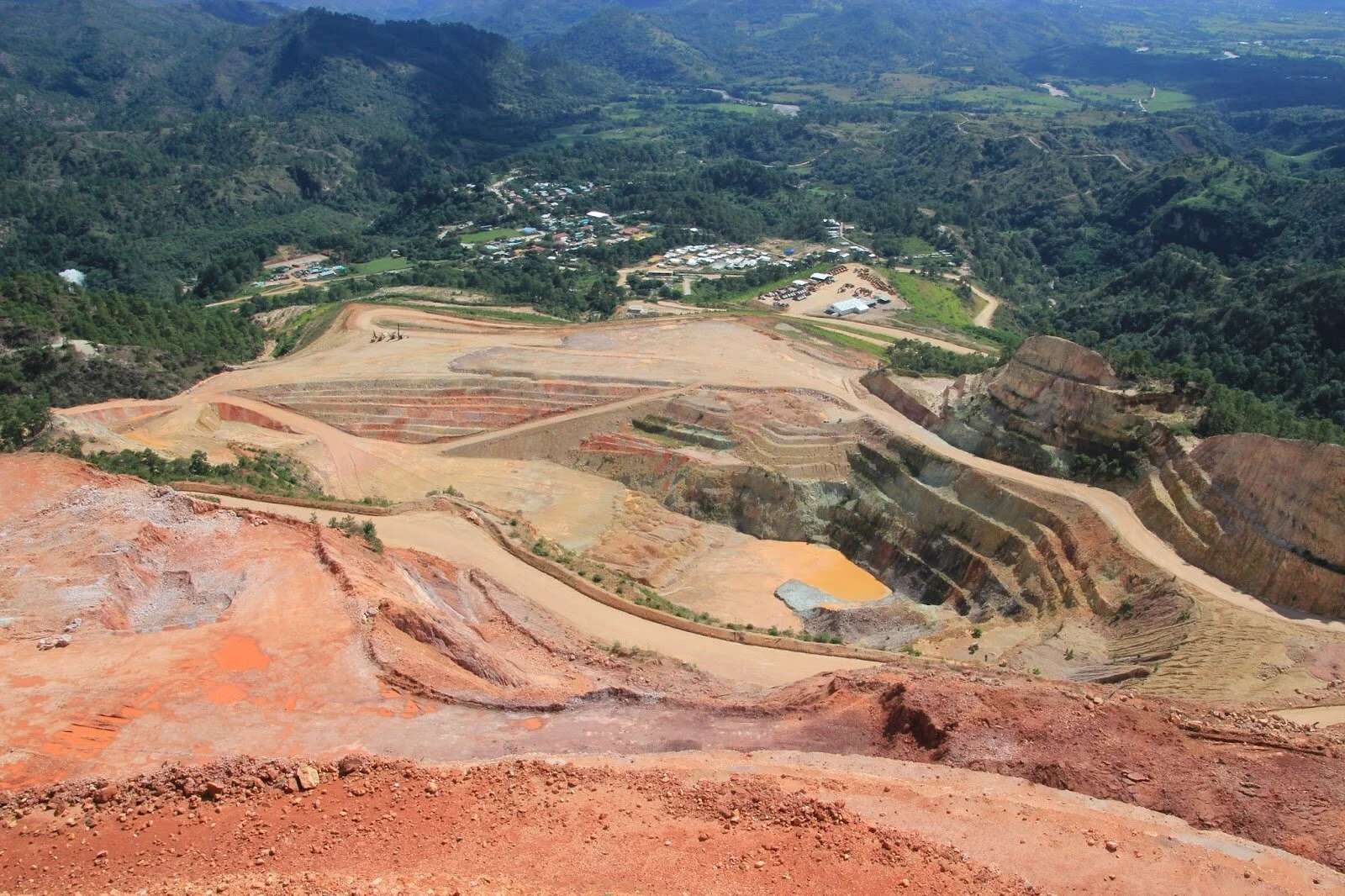
Aura Minerals Mine in Azacualpa, Honduras
Controversial Aura Minerals “Era Dorada” mining project in Guatemala moves forward
By Prensa Comunitaria, February 6, 2026
https://prensacomunitaria.org/2026/02/avanza-polemico-proyecto-minero-antes-cerro-blanco-en-la-frontera-con-el-salvador/
The mining company Aura Minerals has begun a new phase of work at the Cerro Blanco mine, located on the border between Guatemala and El Salvador. Environmental organizations insist on the risk of water contamination, while the Canadian company resumes operations from its previous owner on the same project.
The Canadian mining company Aura Minerals announced the start of new activities in the “Era Dorada” project, formerly known as Cerro Blanco, located in the border area between the municipalities of Jutiapa, in Guatemala, and Metapán, in El Salvador. The announcement was made in early January this year in an official statement.
According to the company, the first tasks in this stage are related to “environmental programs, management and adaptation of the natural environment, improvements in road connectivity and internal access, water management in the mine area, and land adaptations for the installation of temporary infrastructure.”
Aura Minerals assures that it has the necessary technical and environmental licenses to carry out underground mining at Cerro Blanco, located in the municipality of Asunción Mita, Jutiapa. In recent years, environmental organizations have denounced alleged irregularities in the approval processes granted to companies that were previously in charge of the project.
Several media outlets reported on January 7 that the company acquired the project “with all preliminary licenses for the underground mine and received the final construction license on January 6.”
Up until January 13, 2025, the Cerro Blanco project belonged to Bluestone through its subsidiary Elevar Resources. In January 2024, that company reported that the Ministry of Environment and Natural Resources (MARN) had approved a modification to the original permit to allow open-pit mining.
However, in June of that same year, Patricia Orantes, Minister of Environment and Natural Resources, and Víctor Ventura Ruiz, Minister of Energy and Mines, announced the cancellation of the open-pit mining permit, leaving the underground mining license in effect.
Aura Minerals reiterated that the Cerro Blanco project will be developed solely through underground mining. According to the company, this decision is in line with its approach to reducing the impact on the environment and nearby communities.
“Dialogue with the community”
In November 2025, Rodrigo Barbosa, president and CEO of Aura Minerals, participated in the United Nations Forum on Business and Human Rights, an event held at the Human Rights Council in Geneva, Switzerland. Barbosa spoke about the importance of responsible management of mining activities and respect for human rights and the environment.
The affected communities in Guatemala, located 9,500 kilometers from the forum, did not participate in this forum.
During his speech, Barbosa criticized mining practices that, he said, have caused social and environmental damage to communities, and assured that Aura Minerals seeks to differentiate itself from those models.
The executive said that as a company, every decision they make takes into account the impact on communities and the environment, acting ethically and responsibly to mitigate negative impacts and promote positive ones.
Regarding Cerro Blanco, Barbosa noted that since the company acquired the project, they have held discussions with communities, local authorities, and other stakeholders. He stated that these approaches seek to explain the project and address residents' concerns, arguing that sustainable mining is not possible without the support of the population.
Barbosa acknowledged that the company that previously managed the project faced conflicts with the communities. He indicated that Aura Minerals has been engaged in dialogue for over a year, which he described as necessary to obtain what he called a “social license.”
The new company reported that it has held roundtable discussions to share technical information and address the concerns of the population, with the aim of strengthening its relationship with the community based on transparency and respect.
“The progress of the Era Dorada project is the result of an institutional and technical process and ongoing dialogue with communities and authorities,” Barbosa said.
Regarding one of the main fears expressed by local residents and environmental organizations, the possible impact on water sources, Barbosa assured that the mine's operations use recycled water and denied that polluting discharges are made into rivers or other nearby bodies of water.
“We do not discharge contaminated water into the environment; we are recycling it 100%. This is an example of contributing to the resolution of environmental, economic, and social problems,” he emphasized.
Environmentalists insist on the risks
A month and a half after the mining company participated in the 14th United Nations Forum on Business and Human Rights, communities are dismissing several of the statements made by the businessman. The communities are demanding the complete closure of the mining project.
Environmental and community organizations in Guatemala and El Salvador reiterated that the Cerro Blanco mining project—now called “Era Dorada”—poses a risk to water and the environment, and they maintain their questions about the process by which permits for the project were granted, despite the information presented by the company.
According to environmentalists, the environmental management plan presented in 2021 by Bluestone, the mine's former operator, included a system of wells and tunnels whose water would be discharged into the El Tempisque stream.
This tributary flows into Lake Güija and connects to the Lempa River, a basin on which a large part of the Salvadoran population depends for human consumption, agriculture, and industry.
Environmentalists pointed out that, according to academic studies, the area where the mine is located has sensitive hydrogeological conditions. In a study conducted in 2010, Professor Dina López of Geochemistry and Hydrogeology at Ohio University warned that Cerro Blanco mining activity could affect nearby bodies of water.
Among the possible impacts, López pointed out that the discharge of hot water and the presence of geothermal chemicals in the Ostúa River could reduce dissolved oxygen, which would affect the diversity and migration of aquatic species.
He also warned that contact between acid mine drainage and river water could alter the pH (acidity or alkalinity), directly affecting the sediments where small organisms live and fish reproduce, as well as causing pollutants to flow into Lake Güija.
This lake is part of the Güija Complex, declared a Ramsar site of international importance in 2010 and recognized as a protected area of tropical dry forests. At least 14 native fish species have been identified in the area, which is also home to endangered species and local and migratory birds.
Pedro Cabezas, a member of the Central American Alliance Against Mining (Acafremin), recalled that the environmental impact study presented by the previous company has been questioned by international academics. He pointed out that if the current operator proposes changes to the water management system, these should be subject to public and independent evaluation.
“If they say they are going to use a new system, we want to see it so that it can be scrutinized by experts, who can tell us whether the company has a viable system or not,” said Cabezas.
Cabezas also called on Guatemala's environmental authorities to be transparent about the criteria and procedures used to grant permits for the project. He stated that, so far, the environmental indicators mentioned by the company have not been subjected to public technical scrutiny.
“The company is saying internationally that they have a new construction permit and they are talking about environmental indicators that have not yet been subjected to public scrutiny,” claimed the environmentalist.
Prensa Comunitaria requested a copy of the environmental permit from the Ministry of Environment and Natural Resources (MARN) through public access to information, but as of the publication of this article, there has been no response.
Controversial municipal consultation
For his part, Julio González, a member of the Madreselva collective, asked that the municipal consultation held on September 18, 2022, in Asunción Mita, in which part of the population voted to decide on mining in the area, not be dismissed.
Only 8,503 of the 30,465 people eligible to vote participated in this consultation, and of those who voted, 87% rejected mining.
However, the Constitutional Court (CC) invalidated the municipal referendum by declaring three articles of its regulations unconstitutional, considering that municipalities do not have direct jurisdiction over the use of natural resources, a power that corresponds directly to the State, as established by the Constitution.
“Despite a flawed ruling by the Constitutional Court, the technical and legal consultation is still valid,” González insisted.
Background
Aura Minerals in Honduras: https://rightsaction.org/aura-minerals-archives
US-Backed Canadian Mine in Guatemala Threatens Water Supply for Millions, by Michael Fox, May 27, 2024, https://truthout.org/articles/us-backed-canadian-mine-in-guatemala-threatens-water-supply-for-millions/
More information
Observatorio de Industrias Extractivas, https://oiegt.org/, https://twitter.com/oie_gt
Madre Selva Colectivo Ecologista, colectivomadreselva2@gmail.com, https://madreselva.org.gt/
ACAFREMIN, Alianza Centro Americana frente a la minería, info@acafremin.org, https://acafremin.org/es/contactenos