
Remembering the victims of the Panzos massacre
Linked to Canadian company INCO, precursor to Hudbay Mineral’s mining violence 30 years later
By Grahame Russell, May 29, 2026
In Rights Action’s report 13 BRAVE GIANTS-How We Won the Landmark Hudbay Minerals Lawsuits in Canada, the Mynor Padilla Criminal Trial in Guatemala, and at What Cost!, I set out how:
“In the 1970s and 1980s, [the Canadian mining giant INCO-International Nickel Company] not only had an economic partnership with the military-backed governments, who were minority owners of the Fenix mine operation, but also a security partnership. Those arrangements were such that the Guatemalan army established a military outpost on INCO property, used INCO’s landing strip to transport military personnel and hardware, and used INCO vehicles to transport personnel and equipment throughout the region.”
“It is remembered today by Q’eqchi’ villagers that INCO directly supported soldiers and police on May 29, 1978, the day of the Panzos massacre. Hundreds of Q’eqchi’ farmers had gathered in the Panzos town square, 30 km west of the Fenix mine plant, to protest corrupt and violent land theft occurring throughout the region, the biggest culprit being INCO. Over 140 villagers were slaughtered that day, mostly in the town center.”
Panzos Massacre: “First large-scale massacre of the scorched earth era”
In the book TESTIMONIO-Canadian Mining in the Aftermath of Genocides in Guatemala, Sandra Cuffe writes:
“On May 26, 1978, civilians travelling in private vehicles and an [INCO] company truck opened fire on residents of Chichipate, ten kilometres west of the main mining company installations and plant. Two local men, Miguel Sub and José Ché Pop, were injured.
“Three days later [on May 29], the first large-scale massacre of the scorched earth era took place in Panzós, twenty-five kilometres west of Chichipate. Hundreds of Q’eqchi’ from communities throughout the region mobilized to Panzós for a march for land rights culminating in the central plaza. The army opened fire on the crowd, killing dozens and possibly even upwards of one hundred people. According to some reports, prior to the massacre, Q’eqchi’ travelling on foot from El Estor and Chichipate to join the mobilization in Panzós were shot at by men in [INCO] trucks along the way.
“The following month, in June 1978, military commissioners and [INCO] employees shot and killed four people in a village in the municipality of Panzós.
“In July 1978, General Romeo Lucas García took office. During his presidency—which coincided almost completely with the period in which the nickel mine was in production in El Estor—counterinsurgency operations, attacks on civilians, and massacres of Indigenous communities became the national norm.
“In communities around INCO’s mine, attacks against and disappearances of local Maya Q’eqchi’ leaders continued, with at least one more documented case of direct mining company involvement. On January 31, 1981, judicial police travelling in an [INCO] truck executed Chichipate community leader Pablo Bac Caal.”
Zero oversight or accountability in Canada
As I set out in What the Landmark Hudbay Minerals Lawsuits Exposed and Left Unresolved:
“Both the Canadian government and INCO would hold extensive records from this period. None of these issues have been examined. Had there been accountability for any of this — in Ottawa, in Canadian courts — it is unlikely that Skye Resources and Hudbay Minerals could have moved into Guatemala in the 2000s and operated as they did.”
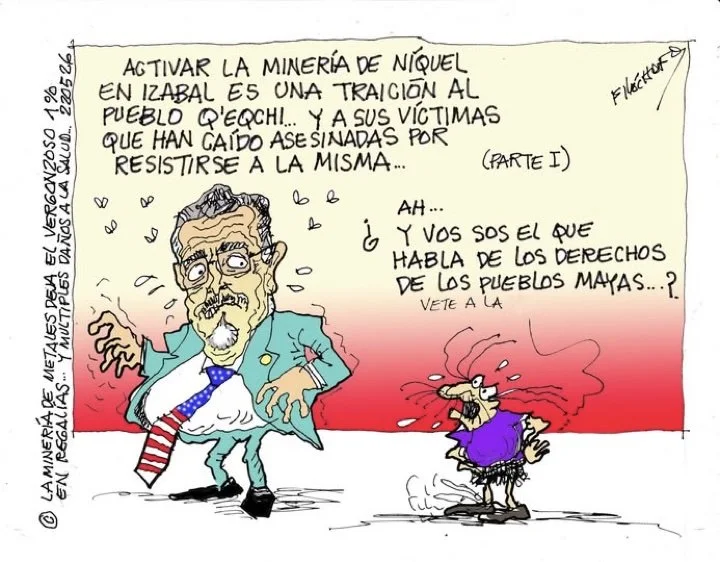
“Re-opening nickel mining in Izabal is a stab in the back of the Q’eqchi’ People, and their victims who have been assassinated resisting nickel mining …”
“Ah, … and you [President Bernardo Arevalo, wearing U.S.A. flag] who talks so much about the rights of Maya Peoples …? Go to … ”
Sidebar: “All that metallic mining leaves in Guatemala is a shameful 1% of royalties plus multiple harms …”
FILOCHOFO, May 22, 2026
60-year nightmare of mining in Q’eqchi’ territories to continue
On May 19, 2026, the Guatemalan government gave the green light for the Swiss company Solway Investment Group (and its U.S.-subsidiary Fenix Nickel Company) to re-open this same Fenix mine operation in the Q’eqchi’ territories of El Estor.
As we remember and commemorate the lives of the Q’eqchi’ victims of the mining-linked Panzos Massacre in 1978, we fear that mining-linked violence and dispossession, corruption and impunity will begin soon again in the Q’eqchi’ communities and lands of El Estor and Panzos.