
Green light for Solway Investment Group to re-open Fenix Mine in Guatemala 60-year nightmare of mining in Maya Q’eqchi’ territories of El Estor to continue
June 1, 2026, by Rights Action (and collaboration with Aj Ral Ch'och')
On May 19, 2026, it was announced that Solway Investment Group (Switzerland) and its subsidiary Fenix Mining Company (U.S.) reached an agreement with the Guatemalan government to re-open the notorious Fenix mine on the ancestral lands of the Q’eqchi’ people and communities in El Estor, Izabal, and Panzos, Alta Verapaz.
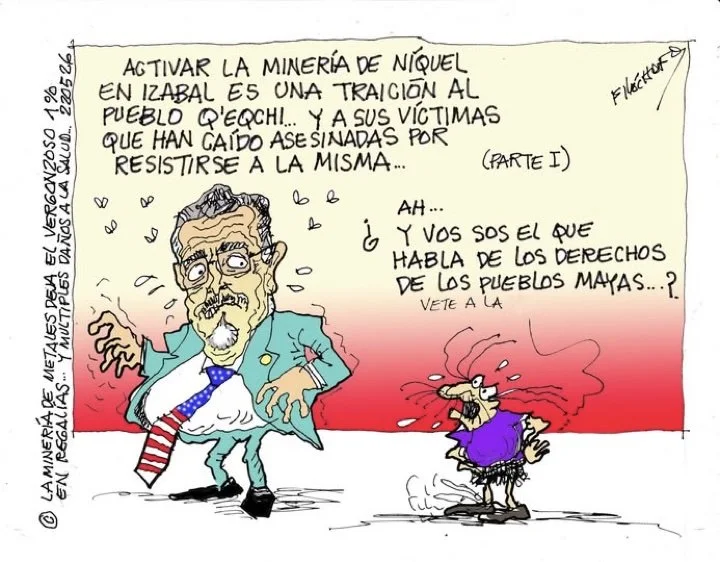
“Re-opening nickel mining in Izabal is a stab in the back of the Q’eqchi’ People, and their victims who have been assassinated resisting nickel mining …” “Ah, … and you [President Bernardo Arevalo, wearing U.S.A. flag] who talks so much about the rights of Maya Peoples …? Go to … ” Sidebar: “All that metallic mining leaves in Guatemala is a shameful 1% of royalties plus multiple harms …”
Author FILOCHOFO, May 22, 2026
In 1955, one year after the U.S.-coup ousted the government of President Arbenz, the Hanna Mining Company (U.S.) received a mineral exploration license in El Estor. Hanna was the first beneficiary of Decree #272 established by the post-coup military dictatorship to facilitate large-scale mineral exploration.
By 1960, Hanna had invited the Canadian mining giant INCO (International Nickel Company) to form a joint venture that led to the establishment of EXMIBAL (Exploraciones y Explotaciones Mineras Izabal S.A.). INCO held 80% of the common shares, while Hanna held 20%.
Thus began the 60-year nightmare of mining in the Q’eqchi’ communities and lands mainly of El Estor, and also Panzos and Livingston.
1964-2004: INCO (Canadian owner) and EXMIBAL (Guatemalan subsidiary)
2004-2008: Skye Resources (Canadian, incorporated by former INCO directors) and CGN (Compania Guatemalteca de Niquel, new name of EXMIBAL)
2008-2011: Hudbay Minerals (Canadian, purchased Skye Resources and Fenix Mine) and CGN
2011-2022: Solway Investment Group (Swiss) bought the Fenix Mine from Hudbay Minerals
2024: Under direct pressure from the U.S. government, Solway Investment Group incorporated the new subsidiary Fenix Nickel Company in the U.S. which became the legal owner of CGN and PRONICO
Over the past six decades, these companies—supported by their home governments, investors, and military-backed governments in Guatemala—have exploited nickel, rare earth elements, and other minerals in the region, systematically causing: environmental and health harms, violent evictions of entire communities, assassinations and deaths, sexual violence against women, and the criminalization of countless residents of El Estor and Panzós.
No consultation, No reparations
It is a story of oppression and dispossession that has lasted for more than 60 years, without ever consulting the affected communities or providing reparations for the damages and violences caused along the way.
On May 13, 2024, the Q’eqchi’ Maya Ancestral Council issued a statement in response to the possible reactivation of the Fénix mining project, making several demands of the government and the Solway Investment Group:
Suspension of mining operations in the Q’eqchi’ region of El Estor and Panzos
Establishment of an independent commission to thoroughly investigate the true impacts of mining from 2004 through 2024
Preparation of a compensation plan for the individuals and communities who have suffered violence, harm, and criminalization over the course of these 20 years of mining
Carrying out a legal and transparent consultation, based on prior and complete information, in the ancestral Maya Q’echi’ language
“We believe that there can be no talk of reviving the mining project in El Estor unless the communities’ demands and requests are met,” said Humberto Cuc, an ancestral leader of the Q’eqchi’ Maya Council. “We have suffered evictions, criminalization, murders, states of emergency, and raids on our homes,” said Julio Anselmo Toc, of the El Estor artisanal fishermen’s association.
The government and company simply turned a blind eye to the just demands of the Q’eqchi’ communities.
How the U.S. got effective control over the resources produced at the Fenix Mine?
It appears that U.S. markets are the primary beneficiary of the extraction to come. Based on a variety of sources, Grahame Russell wrote in May 2024:
“[T]he US took advantage of the Russian invasion of the Ukraine in 2022 to force the suspension of the Fenix mine [in 2022], using the excuse that Russians with interests in Solway engaged in acts of corruption in Guatemala. After over a year of backroom discussions and lobbying by top-end Washington DC insiders, such as Lanny Davis & Assocs., the blacklisted Russians were removed from the company and the sanctions were lifted in early 2024. As part of the deal to lift sanctions, Solway incorporated the U.S.-based Fenix Mining Company that became the new owner of the Fenix mining operation in Guatemala. It is speculated that as part of the deal, Solway agreed to sell all or a significant amount of the nickel and other minerals to US markets.”
“In April 2023, Newsweek Magazine reported that the reason the US imposed sanctions on Solway was that “amid increasingly intense competition with China over strategic resources such as nickel, which is key to technologies including electric cars”, the US wanted access to the extensive nickel and other mineral resources found in the Q’eqchi’ territories of eastern Guatemala.”
Sacrifice zones of the Q’eqchi’ territories
With the reactivation of the Fenix Mine on May 19, 2026, the harms and destruction of the past remain open and unaddressed.
If the last 60 years of the Fénix Mine are any indication—let alone since 2011, when Solway Investment Group purchased the operation from Hudbay Minerals—the Q’eqchi’ people and the communities of El Estor and Panzos will suffer further health and environmental harms, evictions, and human rights violations.
So it goes in the sacrifice zones of the Q’eqchi’ territories of eastern Guatemala. Global mining companies and investors, backed by their home governments, make deals and flip companies back and forth to maximize their own political and economic interests.
The Q’eqchi’ people, considered “illegal squatters in the way of development” on their own lands, have no say in the matter and get steamrolled decade after decade.
Mas informacion
El Estor: Humberto Cuc, autoridad ancestral del sur de El Estor, +502-4916-5681
Canada/U.S.A.: Grahame Russell, Rights Action, grahame@rightsaction.org
Background
TESTIMONIO-Canadian Mining in the Aftermath of Genocides in Guatemala
What the Landmark Hudbay Minerals Lawsuits Exposed and Left Unresolved
More info
Observatorio de Industrias Extractivas, https://oiegt.org/, https://twitter.com/oie_gt
Change media sources
Rights Action urges folks to diversify news sources as an antidote to the oftentimes propagandistic reporting coming from government and corporate media in the U.S. and Canada. Gray Zone, Democracy Now, DropSite News, Real News Network, CounterPunch, Intercept, Canadian Foreign Policy Institute, Breach, rabble.ca, Orinoco Tribune, Al Jazeera News (for Palestine related reporting)