
PETITION: Calling for crimes against humanity trial in Canada against former Guatemalan military officer Jorge Vinicio Sosa Orantes
“In the Dos Erres case, Canada’s decision hurt Ramiro Osorio Cristales most directly: the country that offered him refuge after he fled Guatemala is the same country that harbored one of his family’s murderers for decades and now refuses to prosecute him for his crimes.”
(NSA article, below)
Rights Action calls on folks in Canada and the U.S. to sign and share this petition calling for a crimes against humanity prosecution in Canada against former Guatemalan military officer Jorge Vinicio Sosa Orantes who oversaw and participated in the December 6-7, 1982 Dos Erres massacre of over 200 Mayan villagers in Guatemala.
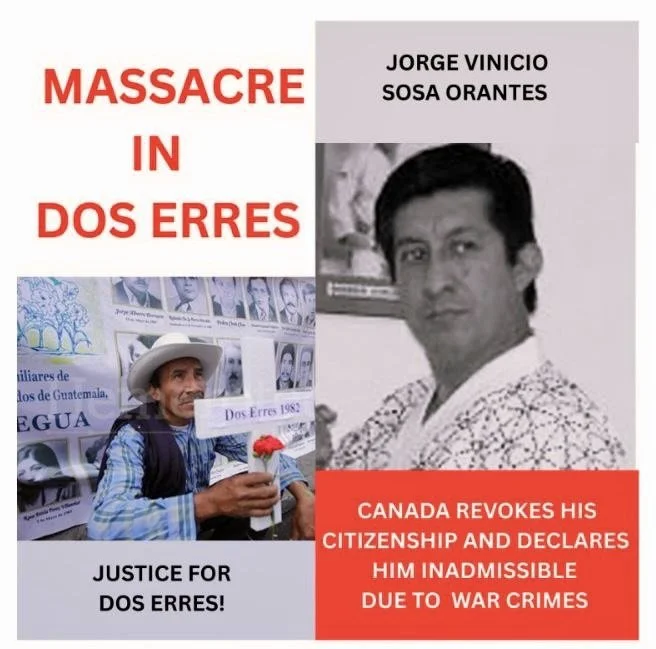
As explained by the National Security Archives (NSA) article below, the Canadian government had the clear opportunity in 2011 to return Mr. Sosa Orantes from Canada to Guatemala where he would have, in all likelihood, faced a crimes against humanity trial when the justice system was filled with principled, capable prosecutors, investigators and judges.
Canada chose not to. They deported him to the U.S., to face some minor charges there. Soon enough, Sosa Orantes was able to return to Canada and continue living under false pretences.
Sign petition: https://forms.gle/8SUtpAF3eZyJfeTR6
Deadline: March 31
Please share this petition widely
Please send your own letters to your MP and to the government official listed below
To understand why this prosecution can and should occur in Canada, we share this in-depth article from the National Security Archives (NSA) about the Dos Erres massacre, about the war criminal Jorge Vicente Sosa Orantes who became a Canadian citizen under false pretences, and about Canada’s obligations to prosecute war criminals.
The Long Shadow of Dos Erres
NSA, February 24, 2026
https://default.salsalabs.org/T68f43761-b364-4f8c-8ab7-147393bb9dc4/d6adc487-43c9-4c7b-80a5-24fe3edfc487
After a decade-long investigation and a trial lasting more than five weeks, a federal court in Ottawa has ruled to revoke the Canadian citizenship of a Guatemalan military officer who participated in a horrific and notorious massacre of hundreds of innocent civilians in 1982.
The February 5 decision also concluded that Jorge Vicente Sosa Orantes, a former second lieutenant and member of the Kaibiles special operations force, committed crimes against humanity when he took part in the slaughter of men, women, and children living in the tiny settlement of Dos Erres, in northern Guatemala. The finding renders Sosa “inadmissible” to Canada and subject to removal from the country.
The National Security Archive’s Kate Doyle gave expert testimony during the trial.
Today, the Archive publishes the court’s ruling as well as U.S. and Guatemalan documents that were used as evidence in the case, including “Campaign Plan Victoria 82,” an essential Guatemalan Army document which established counterinsurgency strategy during the year of the Dos Erres massacre, and which is published today for the first time. Other key records posted today include cables from the U.S. Embassy in Guatemala, which in the immediate aftermath of the massacre named the military responsible.
Judge Roger R. Lafrenière’s ruling is a modest victory in the long, torturous legal case that the Dos Erres massacre represents but a blow for survivors of the massacre and for human rights advocates.
Under universal jurisdiction, Canada has the power to prosecute perpetrators for the worst international crimes, including genocide and crimes against humanity, and it chose not to do so. Instead, the government pursued administrative sanctions against Jorge Sosa, sparing him from facing accountability for his role in the atrocities he is alleged to have committed.
Ramiro Osorio Cristales, survivor of Dos Erres massacre, living as a refugee in Canada
One massacre survivor reacted with disbelief to the court’s decision. Ramiro Osorio Cristales was five when his family was killed in Dos Erres. He lives in Canada as a refugee and served as a witness in the Ottawa trial. When the ruling was issued, Osorio gave a statement expressing his disappointment.
“All they’re going to do is take away his citizenship and expel him. There will be no justice. In reality nothing has been done, or almost nothing… What we wanted was for him to pay for his actions and be tried for his crimes.”
Widespread and systematic attack
As Judge Lafrenière stated in the preamble of his decision, the Dos Erres massacre took place within the context of a “widespread and systematic attack perpetrated by the Guatemalan military against the civilian population in the 1980s.”
The violence was part of a bloody civil conflict that raged intermittently in Guatemala for almost four decades, from 1960 until a peace accord was signed in 1996. The war pitted government forces against armed insurgencies, militant social movements, and anyone suspected of subversive sympathies, including entire communities. When the fighting ended, some 200,000 Guatemalan civilians were dead or missing and at least one million people had been displaced.
In 1999, a United Nations-sponsored truth commission found that 93 percent of documented human rights abuses during the war were committed by “state forces and related paramilitary groups.” According to the commission, the army exterminated 626 villages and smaller settlements in “scorched earth” operations that swept across rural Guatemala[1].
Dos Erres was one of them.
On the night of December 6, 1982, a platoon of 40 soldiers led by an elite unit of Kaibil special forces left their army base in the Petén for Dos Erres, an agricultural community of about 300 people identified by Guatemalan military intelligence as sympathetic to the armed insurgency. The troops arrived at the settlement in the early morning hours of December 7. They were dressed as guerrillas so as to confuse the residents about their identity.
The soldiers went from house to house, waking families and pulling them into the town center. They sequestered the men inside the school and the women and children in an evangelical church. The massacre began when one of the soldiers threw an infant down a deep, dry well. The Kaibiles tortured the men and raped many of the girls and women before killing them and throwing their bodies into the well.
By the evening of December 7, they had murdered most of the Dos Erres inhabitants, including the children. As the Canadian judgement described,
On the morning of December 8, as the patrol unit was preparing to leave, some unsuspecting people arrived in the hamlet. With the well already full, they were taken to a location half an hour away and executed. Two teenage girls who were kept alive by the patrol unit were raped repeatedly and later strangled to death. Only two young boys, one with uncommon light-coloured eyes, are believed to have survived. When the patrol unit left Las Dos Erres, the village was effectively wiped off the face of the earth. (pp. 6)
More than 250 people are believed to have died in the massacre.[2]
The Kaibiles were soldiers trained in special counterinsurgency and counterterror operations, notorious for their use of torture and extreme brutality.
In the Canadian judgement, Jorge Sosa Orantes was identified as an instructor at the Kaibil School and “one of the officers in command of the operation at Las Dos Erres.” (pp. 3-4)
Based on witness testimony and other evidence introduced at trial, Judge Lafrenière found that Sosa directly committed murders of villagers, that he abetted the murder of villagers by his subordinates, and that his acts were committed “as part of the broader attack against civilians at or around Dos Erres” (pp. 6).
“A Consummate Liar”
After Las Dos Erres was “wiped off the face of the earth,” Jorge Sosa remained as an instructor at the Kaibil School. His military record from that point indicates that his role in the Dos Erres massacre had no negative effect on his career. He was promoted to full lieutenant and transferred to the conflictive military zone in the Quiché in 1983, where he was a platoon commander. In 1984, he was moved to Guatemala City to work in the Military Academy (Escuela Politécnica).
Sosa deserted the army and went to the United States in 1985, where he requested political asylum, claiming to be an honorable former soldier under death threats from Guatemalan guerrillas. When the U.S. rejected his application, he appealed to the Canadian consulate in San Francisco for refugee status and residency in Canada.
The failed U.S. attempt compelled Sosa to adjust his tactics. As Canadian prosecutors would later document, Sosa now depicted himself as “a forlorn factory worker” who had joined fellow workers to agitate for better labor conditions. After his colleagues were arrested, Sosa told the immigration officers, he was forced to flee Guatemala with his family, “out of fear of political persecution.” (pp. 49)
The story worked. Sosa received a visa for permanent residency in Canada in 1988 and became a Canadian citizen in 1992. Thirty-four years later, Judge Lafrenière would use Sosa’s fraudulent declarations to revoke his citizenship, calling the Guatemalan ex-military member “a consummate liar.” (pp. 116)
These details are public because when the Canadian government brought charges against Sosa Orantes, they were brought on behalf of the Minister of Citizenship and Immigration and the Minister of Public Safety and Emergency Preparedness.
The Ministry of Justice chose not to prosecute the Guatemalan under Canada’s Crimes Against Humanity and War Crimes Act, the 26-year-old law that gives Canadian prosecutors the power of universal jurisdiction. The Justice Ministry never issued a public statement making its decision explicit, and it’s not clear at what point that calculation was made.
When the authorities contacted the National Security Archive in 2016 to inquire whether we would consider participating as experts in the case, they did so through the Crimes Against Humanity and War Crimes Section of Canada’s Department of Justice.
But if Sosa’s citizenship rested on whether or not he gave false information during his immigration interviews, to pronounce him inadmissible the judge had to find “reasonable grounds to believe” that he was guilty of committing the most monstrous of human rights crimes: genocide, crimes against humanity, or war crimes. They would include – to quote Canada’s own law – “murder, extermination, enslavement, deportation, imprisonment, torture, sexual violence, persecution or any other inhumane act or omission that is committed against any civilian population or any identifiable group...”
It’s a finding that the government’s prosecutors presented forcefully in their arguments before the court, in the documents they introduced as evidence, and in the witnesses they brought in to testify.
In his 136-page ruling, Judge Lafrenière used the evidence submitted to examine the patterns of violence committed by the Guatemalan military against civilians in the early 1980s;[3] the military’s counterinsurgency strategy and the structure and operations of the Kaibil special forces;[4] declassified U.S. and Guatemalan records showing that the Dos Erres massacre was consistent with other atrocities committed during the war;[5] and the results of the first exhumations in Dos Erres, carried out in the 1990s by a team of forensic anthropologists.[6]
The Court heard the testimony of a former Kaibil and witness to the massacre who described the actions of then-Lieutenant Jorge Sosa Orantes[7] and the memories of Ramiro Osorio Cristales, one of the only living survivors of the massacre, who – 44 years ago – lost his father, mother, sisters and brothers.[8]
Osorio’s testimony was more than a litany of the horrors he experienced. As the judge wrote in his decision,
He remembers Las Dos Erres as a rural green landscape, inhabited by a farming community. Besides the small wood houses, there was a church and school in the village. He lived there with his mother, Petrona, his father, Victor, and his five siblings. He recalled his youngest sibling, a sister, was around two months old at the time of the massacre. (p103)
Concluding, Judge Lafrenière found that, “in December 1982, Mr. Sosa participated in the horrific massacre as part of the Kaibil patrol operation at Las Dos Erres.” The judge was unequivocal in characterizing the destruction of Dos Erres and the murder of its residents as crimes against humanity. His decision means that Sosa Orantes is now considered inadmissible to Canada and is subject to removal.
But Sosa Orantes continues to enjoy impunity for the massacre itself.
Rhetoric vs. responsibility
Canada has long held itself to be a supporter of international human rights and leader in the implementation of universal jurisdiction. Two years after the adoption of the Rome Statute in 1998, which established the International Criminal Court, Canada became the first country in the world to incorporate the statute’s obligations into domestic law, with approval of the Crimes Against Humanity and War Crimes Act in 2000. The act gave Canada the power to investigate and prosecute suspected perpetrators of international crimes in national courts, whether or not the crimes took place in Canada or the accused were Canadian citizens.
But 26 years later, Canada’s track record on universal jurisdiction is thin. Since the law was ratified, there have been precisely two trials under the act.
In 2005, Rwandan Désiré Munyaneza became the first person to be arrested under the law. He was tried on charges of genocide, crimes against humanity, and war crimes, found guilty in 2009 and sentenced to life in prison. A second Rwandan living in Canada, Jacques Mungwarere, was similarly charged and tried but acquitted in 2013. A third case stems from the 2024 arrest of Ahmed Eldidi, a naturalized citizen accused of dismembering a prisoner on behalf of Daesh (ISIS or the Islamic State) in 2015.
International law experts in Canada have warned for years that the government’s predilection for immigration remedies over war crimes prosecutions damaged Canada’s reputation as a pioneer in universal jurisdiction. In 2010, legal scholar Fannie Lafontaine published a seminal article on Canada’s War Crimes Act, ten years after it became law and in the immediate wake of the Munyaneza conviction.
The authorities “should consider the responsibility that Canada has accepted for itself in the global fight against impunity,” she wrote. “Once a suspect is found on Canadian territory, Canada bears the responsibility of the international community to ensure accountability, in Canada or abroad.”[9]
The experts are also skeptical of Canada’s commitment to follow through with its case against Ahmed Eldidi. After the Eldidi indictment was made public in 2024, Mark Kersten, a professor of criminal justice in British Columbia, observed that “Canada’s ability to prosecute international crimes in Canadian courts has atrophied.”
Avocats Sans Frontières (Lawyers Without Borders) Canada has supported Dos Erres massacre survivor Ramiro Osorio Cristales with legal assistance for more than 15 years. In a recent report, ASF Canada denounced the “clear lack of political will” on the part of Canadian authorities to use the legal tools they had at their disposal to prosecute Jorge Sosa Orantes. While immigration measures such as exclusion or removal “are useful in preventing the country from becoming a refuge for war criminals,” the report pointed out, “they do not fulfill the broader objective of bringing justice to victims and ensuring accountability for these crimes.”
Canada’s single active case related to genocide, crimes against humanity, and war crimes (Eldidi) stands in stark contrast to states that are more actively pursuing universal jurisdiction prosecutions. According to the Geneva-based justice advocacy and research organization TRIAL International in its Universal Jurisdiction Review 2025, France has 26 active cases; Germany has 20, Belgium and the Netherlands have 12 each. Outside of Europe, Argentina has seven cases underway.
What happens now?
It is unclear where Jorge Sosa Orantes is now. He never appeared in the Ottawa courtroom, so he was tried in absentia. In his ruling, Judge Lafrenière wrote that the ex-Kaibil had sworn in an affidavit to the Court that he was living in Alberta; later it became evident that he wasn’t even in Canada at the time. (pp. 117)
Theoretically, if Sosa is in the country, he could be rearrested for crimes against humanity – but it’s extremely unlikely. As ASF Canada’s director of legal affairs, Moussa Bienvenu Haba, explained to us in a recent phone call, the government just invested ten years of investigative resources in an immigration and citizenship case; it would be hard to imagine the Ministry of Justice now deciding to go forward with a second prosecution under the War Crimes Act. In the event that Sosa is still in Canada, the most likely development would be his removal from the country.
It would not be the first time. Sosa Orantes was arrested and removed from Canada once before – in 2011, to the United States. Despite having been refused refugee status by the U.S. in the 1980s, Sosa later married an American citizen and obtained his U.S. citizenship in 2008. When U.S. authorities realized he had lied about his Guatemalan military service on his naturalization application, the Justice Department charged him with fraud and requested his extradition.
At the time, extradition requests from two other countries were in play. One was from Spain, part of a sprawling genocide case being heard in the Spanish National Court, which, like Canada, recognized universal jurisdiction.[10] The other was from Guatemala.
By 2011, Guatemala had a new attorney general named Claudia Paz y Paz who was willing to prosecute historical human rights criminal cases. The first trial of soldiers charged in the Dos Erres massacre ended on August 2, 2011, with the conviction of four former Kaibiles: Daniel Martínez, Manuel Pop Sun, Reyes Collin Golip and Lt. Carlos Antonio Carias.
Each one received a sentence of 30 years for every Dos Erres inhabitant killed (201 were identified in the case) – 6,060 years in all – on charges of murder and crimes against humanity.
Canada could have sent Sosa Orantes to the country of his birth, where he would have faced a trial for the alleged atrocities. Instead, Canada chose to extradite Sosa to the United States, where the most serious charge he faced was falsifying a document. Convicted of fraud in 2014 in California, Sosa Orantes served five years in U.S. federal prison before returning to Canada in 2020.
In the wake of Judge Lafrenière’s ruling, Sosa Orantes will most likely be removed again, this time to Guatemala. But the accountability landscape in the Central American country has radically changed since 2011.
Attorney General Maria Consuelo Porras, who has been in office for eight years, has steadily undermined the judicial system’s capacity to prosecute former members of the military and security forces for human rights violations. Porras has dismantled the Public Ministry legal team that investigated human rights crimes (Fiscalía de Derechos Humanos); she has intimidated, harassed and criminally charged judges who ruled in past human rights trials; and judges loyal to her have ordered the release of military prisoners already convicted for crimes against humanity.[11]
The assault on human rights justice in Guatemala has had a direct impact on the Dos Erres case. From 2011-18, Guatemalan courts held three trials of accused perpetrators and convicted six former Kaibil soldiers for the massacre.
But on November 7, 2023, the first Dos Erres trial held since Consuelo Porras became attorney general concluded with acquittals for all three defendants. One of those was Gilberto Jordán, who in 2010 was convicted by a Florida court for lying about his military service when he applied for citizenship in order to hide his role in the massacre.
As prosecutors told the judge during the trial, the former Kaibil confessed to throwing a baby down the well at the start of the massacre and bringing dozens of other men, women and children to the well to be killed. Jordán received the maximum sentence allowable in the United States for naturalization fraud and served ten years in federal prison.
After his removal to Guatemala in 2020, he was acquitted along with fellow Kaibil veterans Alfonso Bulux and José Mardoqueo Ortiz.
In May 2026, María Consuelo Porras will reach the end of her second and last term in office as attorney general. She will leave behind a justice system in shambles and one that will remain openly hostile to human rights prosecutions for the foreseeable future. If Canada does deport José Sosa Orantes to Guatemala, the prospects for his conviction there now seem dim.
A blow to international justice
During Sosa’s trial in Canada, the government’s prosecutors made a powerful case to find the ex-Kaibil responsible for crimes against humanity. The charge wasn’t necessary in order for Canada to strip his citizenship from him; it was a requirement for his removal from the country. But the attorneys made more than an argument about “inadmissibility.” As prosecutor Sonja Pavic emphasized to Judge Lafrenière during closing arguments, “Your decision will have an impact for the historical record and for the victims and their families.”
The judge’s ruling, which unequivocally frames the atrocities committed in Dos Erres as crimes against humanity, was his answer.
The Crimes Against Humanity and War Crimes Act, however, grants the power to decide whether or not to pursue charges under the Act to one person: Canada’s Minister of Justice. Time and time again, the Justice Minister has chosen not to do so.
In the Dos Erres case, Canada’s decision hurt Ramiro Osorio Cristales most directly: the country that offered him refuge after he fled Guatemala is the same country that harbored one of his family’s murderers for decades and now refuses to prosecute him for his crimes.
But the Dos Erres decision is also a blow against the international rule of law. Canada’s insistence on imposing administrative sanctions on the accused perpetrators of the most horrifying crimes imaginable undermines the law, damages institutions of justice, and privileges impunity. As one of the countries in the world that embraces universal jurisdiction, Canada’s failure to apply its principles in its own federal courts makes the War Crimes Act a hollow promise.
The U.S. documents published today were obtained under the Freedom of Information Act by the National Security Archive. All of them were used as evidence in the Canadian Dos Erres case.
The Guatemalan documents come from the Archive’s research collection. They were obtained over the years through the Archive’s participation in various Guatemalan human rights criminal investigations and trials. The Canadian prosecutors used these four and 23 additional documents given to them by Guatemala authorities as evidence in the case.
“If international human rights law is to be more than a legal theory,” Doyle said, “nations must find the political will to prosecute perpetrators in their own courts. Without the element of justice, universal jurisdiction is a hollow promise.”
For more information
Kate Doyle, National Security Archive, kadoyle@nsarchive.org, http://www.nsarchive.org
Canada has a political and justice debt to people of Guatemala
It is not just the U.S. that has a political, legal, moral debt to the people of Guatemala, albeit an enormous one. Canada has, particularly since 1954, built up quite a debt.
Soon after a U.S.-orchestrated a regime change military coup ousted a democratically elected government in 1954, Canada chose then to establish full diplomatic relations with the post-coup military regimes.
Since that time, Canada has pushed aggressively for the expansion of Canadian economic interests in Guatemala, predominantly in the extractivist sector, maintaining full economic, political, security relations with decades of corrupt and repressive, military-backed 'open-for-global-business' governments.
(Some of this is addressed in the 13 BRAVE GIANTS report, about the landmark Hudbay Minerals Lawsuits in Canada, and in TESTIMONIO-Canadian Mining in the Aftermath of Genocides in Guatemala.)
Even during the very worst years -1978-1983- of the U.S. and Western-backed massacres, disappearances and political killings, and the planning and carrying out of genocides in four distinct Maya regions, Canada maintained relations with the regimes – as did the then Canadian mining giant INCO (International Nickel Company) that kept on with business-as-usual.
Canada should assume its legal and moral responsibility to try Sosa Orantes in Canada for crimes against humanity committed in Guatemala, in accordance with sections 6(1) and 8(b) of the Crimes Against Humanity Act (S.C. 2000, c. 24).
Sign petition: https://forms.gle/8SUtpAF3eZyJfeTR6
Deadline: March 31
Please share this campaign and petition widely
Please send your own letters to Canadian government officials listed below
Send your own letters (feel free to cut’n’paste this information) to your elected MP, and to: Sean Fraser, Minister of Justice: @SeanFraserMP; @seanfrasermp.
Grahame Russell, info@rightsaction.org