
Below: Prensa Comunitaria article: “Rise in Cancer Deaths in Mining Region: Alarming Report from the Guatemalan Ministry of Health”
This mining nightmare / mining harms resistance struggle blew into the open in 2010 when the silver mine was owned and operated by Canadian-U.S. company Tahoe Resources. During Tahoe’s years, the operation was characterized by violence, repression, corruption, and environmental and health harms.
In 2019, Pan American Silver (PAS) purchased the mine from Tahoe. Today, despite a widely publicized consultation process in which mining-impacted Xinka communities overwhelmingly said NO to mining, PAS is pushing hard to somehow get the “permits” to restart the silver mining operation. (Assuredly, they are inspired by Swiss company Solway Investment Group somehow getting the “permits” to re-start the notorious Fenix mine on Maya Q’eqchi’ territories, despite the fact that they never even had a legally required consultation process!)
More corporate explanations about “poor hygiene” - ?
As reports circulate of increased cancer related deaths and arsenic poisoning in and about the Pan American Silver mine, Rights Action supporters may recall the work we supported and were involved with in response to human rights violations, environmental and health harms caused by Goldcorp Inc.’s operations in San Miguel Ixtahuacan (Guatemala) and the Siria Valley (Honduras). (In 2019, Newmont Corp. purchased Goldcorp Inc. and all its mining interests.)
When confronted with substantial evidence of arsenic poisoning and health harms in and around Goldcorp’s mine in Honduras, Tim Miller, then Goldcorp VP for Central America, said in an on-site interview that the health harms were cause by “poor hygiene” and had nothing to do with their cyanide-leaching, open pit gold mine. (Find comments in 10-minute trailer to Steven Schnoor’s 2011 film All That Glitters Isn't Gold).
More ‘business as usual’?
What will PAS say now in response to the documented cancer related deaths and dangerous levels of arsenic in local water systems? What will the Canadian embassy and Global Affairs say?
Rise in Cancer Deaths in Mining Region: Alarming Report from the Guatemalan Ministry of Health
June 15, 2026 By José López
https://prensacomunitaria.org/2026/06/aumento-de-muertes-por-cancer-en-zona-minera-el-alarmante-informe-del-ministerio-de-salud/
A study conducted by the Ministry of Health in the area affected by the San Rafael mine [subsidiary of Canadian mining company Pan American Silver], in Santa Rosa and Jalapa, reveals two serious findings: an increase in cancer deaths in the area and high levels of arsenic in the water, which are considered a threat to the population.
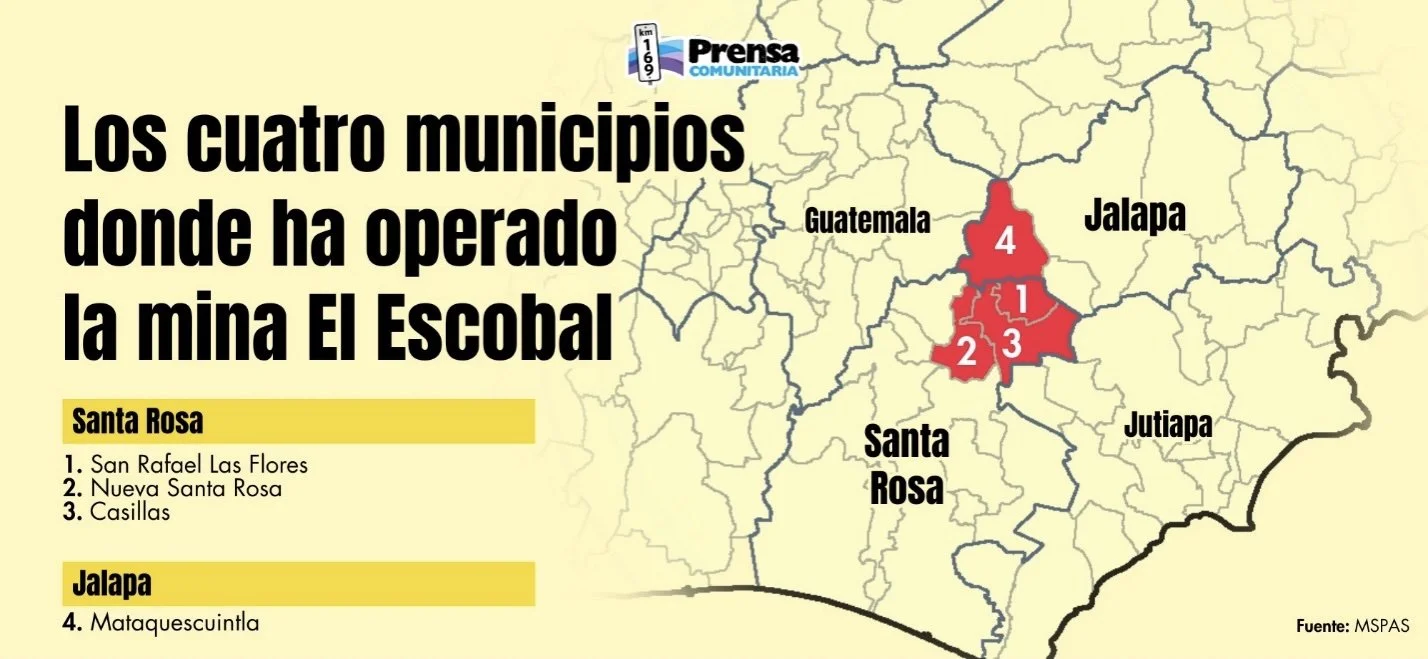
Between 2014 and 2017, the El Escobal mining project operated in Santa Rosa and Jalapa, even though it failed to comply with the consultation process required of the Xinka people living in the region, as established by an international agreement ratified by Guatemala.
Ever since it began mining in those departments, Minera San Rafael—its trade name—has been accused by the local population of contaminating their water sources, harming their health, and causing the deaths of their family members. Their suspicions have not been unfounded.
Prensa Comunitaria obtained a report prepared by the Ministry of Health and Social Assistance (MSPAS) revealing an increase in cancer deaths in the area and arsenic concentrations in the water that exceed safe levels for human consumption.
The four municipalities where the El Escobal mine has operated
Cancer Deaths
The Ministry of Health conducted an analysis of cancer deaths officially reported between 2015 and 2022 in the five municipalities that make up the area of influence of the San Rafael mining company.
The study revealed that the number of cancer deaths in these municipalities is much higher than in the rest of Santa Rosa and Jalapa. In the mining area, there were 38% more cancer deaths—a difference that the Ministry of Health itself describes as significant.
These mortality figures have not remained static over time but have shown a sustained upward trend, which became more pronounced starting in 2019.
Casillas and Nueva Santa Rosa are the municipalities that have shown a clear increase in cancer deaths during the period analyzed. However, the Ministry itself acknowledges that the figure could be higher.
The report warns of a possible underreporting of cases due to the limitations of primary care facilities—community health posts and centers—in diagnosing this disease.
For the Xinka People’s Parliament, […] these findings confirm what they had been denouncing even before the mining project began operations, and the risk posed by the impact on the quality and availability of water for human consumption.
“This is alarming and confirms the concerns that were raised even before the environmental permit was approved. We warned about the possible consequences of failing to include real mitigation measures for this project,” the Xinka People’s Parliament responded in a written statement.
The increase is also reflected in cancer cases. San Rafael Las Flores has the highest number of people diagnosed with this disease. According to the report, the municipality recorded 34% more cancer cases than the other municipalities affected by the mining project.
In an official document, the Santa Rosa Departmental Directorate of Integrated Health Services Networks informed Prensa Comunitaria that, following that investigation, the ministry has continuously maintained records and documentation of cancer and neoplasm—tumor—diagnoses in the department of Santa Rosa, including the San Rafael Las Flores Municipal Health District. “Institutional records show an increase in the number of cases identified in recent years,” although it does not specify the number of cases.
Water Contaminated with a Metal Linked to the Mining Company
The MSPAS report explains that “prolonged ingestion of water containing arsenic is associated with an increased risk of bladder and skin cancer.” It also mentions that cancers of the “lungs, digestive tract, liver, kidneys, and lymphatic and hematopoietic systems” have been linked to arsenic exposure.
That’s not all. According to the Ministry of Health, numerous studies have demonstrated the negative effects of arsenic exposure on people’s cognitive development, intelligence, and memory.
In 2021 and 2022, 1 in 4 water samples analyzed exceeded the permissible limits for arsenic. The situation is most critical in two municipalities: The hardest-hit is Casillas. In this municipality, 38% of the samples showed high levels of arsenic. It is followed by San Rafael Las Flores, where 20% of the samples exceeded the permissible limits for this type of contamination.
With regard to Mataquescuintla, the National Health Laboratory reported that it had not received any water samples during the years analyzed, and therefore was unable to make comparisons to measure arsenic levels in this municipality.
For Magaly Arrecis, a researcher in the environmental department of the Institute of National Problems at the University of San Carlos (IPNUSAC), the Ministry of Health’s study should be more comprehensive and detailed. For example, the specialist explains that the study only indicates the number of locations where elevated levels of arsenic were found, but does not specify the exact amounts, which is a significant omission for assessing the severity of the problem.
“It is extremely concerning that high levels of arsenic have been found, as this puts the population’s health at risk. The data on the amounts detected should be made public, as should any corrective measures that have been taken,” says Arrecis.
The specialist also explains that it is necessary to expand research related to water monitoring, as it should not be limited solely to those municipalities but should also include surrounding areas, particularly by maintaining continuous monitoring in the lower reaches of rivers, where arsenic could also end up.
Arrecís points out that the report also lacks specifics regarding the types of cancer that have increased or data such as the age and gender of those affected, which is crucial for a study of this kind. For Arrecís, another aspect that needs to be evaluated is cases of skin diseases, which are common in areas that have been mined.
Finally, the researcher expresses concern for the future. She warns that if the mining company resumes operations, not only would these findings be sidelined, but there would also be a risk that monitoring and healthcare for the people living in this area would once again take a back seat.
Unlike the Ministry of Health, another study conducted biological tests in the municipalities of San Rafael Las Flores, Mataquescuintla, Casillas, Nueva Santa Rosa, and Santa Rosa de Lima. This study, conducted by the Center for Conservation Studies (CECON) at USAC and the Diocesan Commission for the Defense of Nature (CODIDENA), analyzed people’s urine and determined that those who buy bottled water for consumption have lower levels of arsenic accumulation.
This other study also detected arsenic in water sources at levels above the maximum permissible limit, which is 0.010 milligrams per liter. The findings were made at points where water sources used for crop irrigation originate around the mine. According to the report, this “creates problems and risks for the livelihoods of families who have historically relied on this source as their primary means of livelihood and/or subsistence.”
In addition to concerns about pollution, the Xinka People’s Parliament expresses distrust in the public infrastructure designed to mitigate it. From their perspective, the MSPAS investigation highlighted institutional shortcomings. “The most alarming thing is that the Ministry of Public Health lacks the technical and financial capacity to evaluate and follow up on the monitoring of water sources,” they stated.
Even so, they hope to reach a consensus with the Ministry of Health so that measures can be implemented to address the high levels of arsenic in the water.
A Study That Does Not Name the Culprit
In the study, the Ministry of Health emphasizes that it cannot directly point to the mining company as the cause of these alarming figures. The institution explains that it can only identify “potential risks” associated with exposure and the project’s impact on public health.
Their study is purely “descriptive.” In other words, the research is limited to documenting what is happening in these municipalities—whether there are higher levels of arsenic or more cancer deaths—but it does not use scientific tools or methods to establish a specific cause or assign direct responsibility.
The Ministry of Health has not clarified whether it plans to update this research. Prensa Comunitaria contacted the institution, and they responded that the study was conducted in compliance with a court ruling that ordered consultation with the Xinka people.
“Monitoring the population’s health status is not limited to that study. The MSPAS maintains ongoing epidemiological surveillance in the municipalities of San Rafael Las Flores, Casillas, and Nueva Santa Rosa through continuous monitoring of morbidity and mortality. These actions ensure that up-to-date information is available,” the Santa Rosa Departmental Directorate of Integrated Health Service Networks reported in an official document.
The MSPAS also states that, as part of its ongoing monitoring, it conducts bacteriological and physicochemical analyses of water supply systems for human consumption within that area.
Although the Xinka People’s Parliament asserts that the Ministry of Health itself “has tried to downplay the impacts revealed” by its investigation, it believes that this should be sufficient to halt the operations of the San Rafael mining company.
“These results clearly demonstrate that the Guatemalan government lacks the capacity to guarantee our right to health, given the risks posed by the Escobal mining project, and therefore the project should be permanently suspended,” it declared.
The consultation with the Xinka people, led by the Ministry of Energy and Mines, remains unfinished. The latest update from the institution is that technical working groups will be formed prior to the conclusion of this process, which could signal the end of the project—a suspension of which was formally requested by the Xinka People’s Parliament a year ago, on May 8, 2025.
TESTIMONIO-Canadian Mining in the Aftermath of Genocides in Guatemala (Between The Lines, 2021) addresses both Tahoe Resources/Pan American Silver and Goldcorp Inc. Since 2011, Rights Action has supported community-led resistance to Tahoe Resources/PAS’s harmful mining interests in Guatemala.
More information
Rights Action archive: Pan American Silver (formerly Tahoe Resources)
Ellen Moore, Earthworks, emoore@earthworks.org
Jen Moore, IPS, jenmoore0901@gmail.com
Change media sources
Rights Action urges folks to diversify news sources as an antidote to the oftentimes propagandistic reporting coming from government and corporate media in the U.S. and Canada. Gray Zone, Democracy Now, DropSite News, Real News Network, CounterPunch, Intercept, Canadian Foreign Policy Institute, Breach, rabble.ca, Orinoco Tribune, Al Jazeera News (for Palestine related reporting),
Follow work of other groups
NISGUA (Network in Solidarity with People of Guatemala): www.nisgua.org
GHRC (Guatemalan Human Rights Commission): www.ghrc-usa.org
Breaking the Silence: www.breakingthesilenceblog.com
PLATAFORMA CANADA-Guatemaltecos Exiliados por Terrorismo de Estado, https://www.facebook.com/GuatemaltecosExiliadosCanada