
“We need to refound Guatemala - build a viable Guatemala that stops being captured by organized crime and other de facto powers, by military powers, by the high command, by (economic) groups.”
Ruben Zamora
In these times of utter and complete corruption and impunity, violence and aggression led by the U.S. and supported by key Western allies across the Americas and the Middle East, we share this update about how the struggle against institutionalized corruption, violence and impunity is going in Guatemala.
Below articles about:
Consuelo Porras and forced adoptions of kidnapped infant
The current and corrupt head of Guatemala’s Attorney General’s office, Consuelo Porras, was, during the worst years of the U.S. and Western-backed State repression and genocides in the 1980s, director of the Elisa Martínez Temporary Home that offered into adoption infants kidnapped from their parents by the Guatemalan military regime.
Exiled Judge Miguel Angel Galvez to make a return?
Miguel Angel Galvez, the principled Judge who was criminalized and forced into exile by Consuelo Porras and the AG’s office, is making a possible return to Guatemala if elected judge to the Constitutional Court.
Journalist Ruben Zamora freed after 3 years a political prisoner
Ruben Zamora, the journalist and publisher who was criminalized and jailed for over three years by Consuelo Porras and the AG’s office, has been given conditional release.
From 2018 to the present, Consuelo Porras has been head of the AG’s office and defender-in-chief of the interests of the traditional Guatemalan elites (“pact of the corrupt”) and their global business partners and political allies. She has overseen campaigns of lawfare, criminalizing lawyers, judges and prosecutors, and land, rights and environmental defenders, while freeing convicted war criminals and people found guilty of participation in organized crime networks.
Porras and the AG’s office have done this all the while providing the veneer of legality to global companies, banks and investors that claim to be abiding by the rule of law.
Battle for Guatemala
As the U.S. aggressively and violently pushes a regime change agenda across Latin America – accepted by acquiescent silence, or openly supported by Canada and the usual European suspects -, Guatemala will come back into the spotlight through 2026 and into the 2027 election year.
It is crucial to support efforts to wrest all power and control from Consuelo Porras, and celebrate the conditional freedom of Ruben Zamora and hoped-for return of exiled Judge Galvez, who have worked for decades to investigate and reporting on abuses of power and authority, and to strengthen the rule of law.
The battle for the future of Guatemala plays itself out in Washington and capitals of the West, and it plays itself out one human rights struggle at a time in Guatemala.
Consuelo Porras accused of illegal adoptions by UN experts
By Simon Antonio Ramon, Prensa Comunitaria,
https://prensacomunitaria.org/2026/02/consuelo-porras-senalada-de-adopciones-ilegales-por-expertos-de-onu/
A group of United Nations (UN) experts reported that they received complaints about illegal international adoptions of at least 80 indigenous children from Guatemala, following their illegal detentions and forced disappearances between 1968 and 1996, who were institutionalized in the Elisa Martínez Temporary Home.
These reports include information implicating Guatemala's current attorney general, Consuelo Porras.
The experts called for independent investigations into allegations that public officials at the time were involved in these illegal international adoption processes. “This includes the former Director/Administrator of the Elisa Martínez Temporary Home, María Consuelo Porras Argueta (now Attorney General and Head of the Public Prosecutor’s Office of Guatemala) who, according to reports, was the children’s ‘legal guardian’ from January 21 to August 30, 1982.”
In the press release, they expressed their concern “that no prompt, thorough, independent, and impartial investigation has been conducted into the alleged involvement of some state authorities in these processes.”
Call for caution in appointing judges
The group of experts urged the bodies responsible for second-level elections to exercise caution when appointing individuals who have been accused of serious allegations that have not yet been investigated, such as Consuelo Porras, who ran for judge of the Constitutional Court (CC).
“All individuals against whom there are credible allegations of conduct incompatible with human rights standards, especially those who have had the authority to make decisions related to criminalization or human rights violations, should not be shortlisted or appointed until a prompt, independent, and thorough investigation of those allegations has been conducted,” they said in the statement.
UN officials called on the Guatemalan government to investigate those responsible for this incident. “The victims have the right to access all remedies available under international and national law, including judicial and non-judicial mechanisms, truth-seeking initiatives, criminal proceedings, reparations, and guarantees of non-repetition.”
Consuleo Porras and her time at the Public Prosecutor's Office
Porras was included in the list of six professionals selected by the Nominating Commission in 2018, which was presented to then-President Jimmy Morales with a score of 75 points.
In 2022, she was included in the list of candidates for attorney general after the Constitutional Court (CC) granted an injunction to lawyer Erick Castillo, who acted on her behalf when the list was being drawn up, as she was in danger of being excluded from the list that would be sent to Alejandro Giammattei due to allegations of human rights violations. A few days later, Giammattei re-elected her as attorney general.
In September 2021, she was included in the List of Corrupt and Undemocratic Persons by the U.S. Department of State for North and Central America, known as the Engel List.
Since January 2024, she has been banned from entering 40 European countries as a result of sanctions imposed by the European Parliament for attempts to overturn the 2023 election results.
Miguel Ángel Gálvez enters race for seat in the Constitutional Court0
By Alexander Valdez, Prensa Comunitaria
https://prensacomunitaria.org/2026/02/miguel-angel-galvez-reaparece-y-entra-a-la-contienda-por-un-puesto-en-la-cc/
The man who once heard and judged the first major trials that shook the country's political and economic elites, with cases involving high-ranking officials accused of corruption and crimes against humanity, as well as gangs and drug traffickers, now enters the electoral race for the Constitutional Court.
He had to leave his position as judge after reporting threats and a campaign of criminalization that forced him into exile.
We are talking about former Judge Miguel Ángel Gálvez, who served as a justice official for 23 years and whose name also appeared on the final list of candidates for attorney general of the Public Prosecutor's Office in 2018. He was not selected by then-President Jimmy Morales. Now, years later and under different personal circumstances, he is seeking to return to the justice system, but this time from the Constitutional Court.
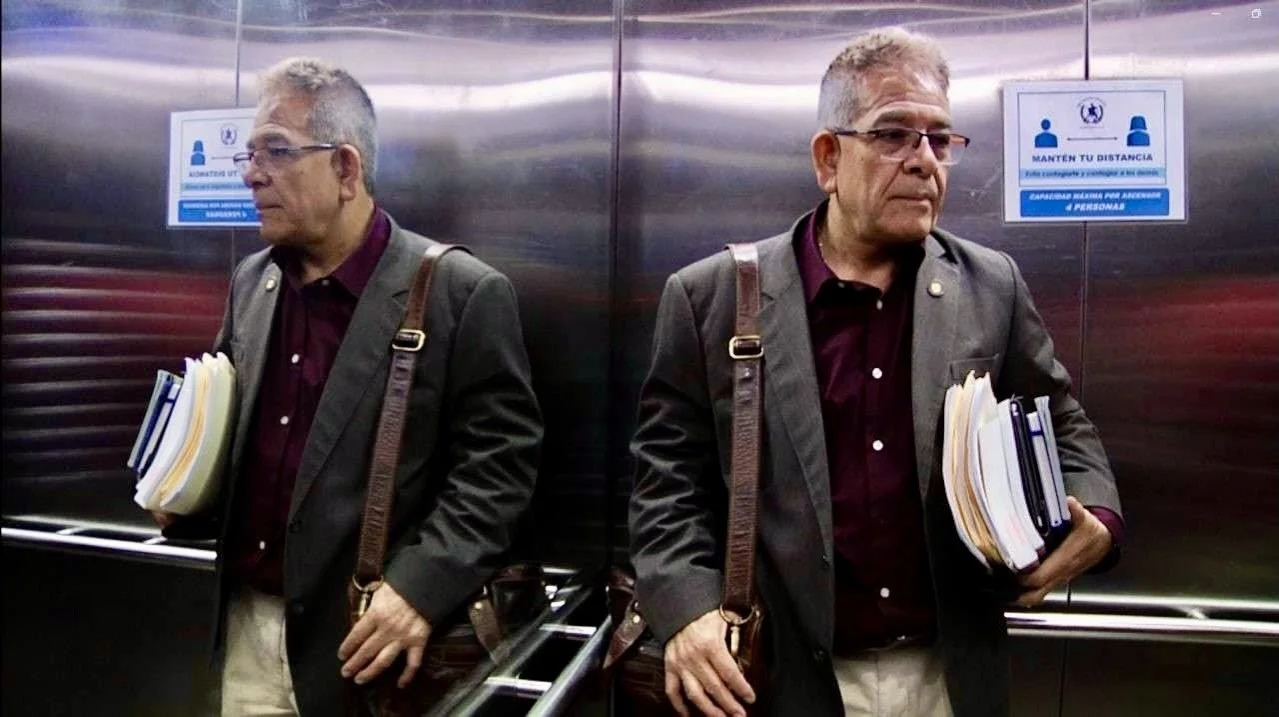
Credit: PC Archive
He did not present his candidature in person. The risk, as he has reported, of possible criminalization by the AG Consuelo Porras still persists. Although he was removed from the judiciary and forced into exile, there is currently no arrest warrant against him. It is in this context that Gálvez reappears on the public scene.
His file will be reviewed by President Bernardo Arévalo, from a very different political party than the one Gálvez faced in 2018. It was during Jimmy Morales' administration that his name was included in the final list of candidates to head the Public Prosecutor's Office, but he was not chosen. Instead, Porras was appointed, a figure who is now the target of much criticism in the country.
Exile
Although there is no active arrest warrant against him, the Judge Galvez has remained outside the country to protect his safety and out of fear that the Public Prosecutor's Office will bring criminal charges against him, as has happened with other justice officials who are now facing one or two arrest warrants that prevent them from returning to Guatemala.
Abroad, he has received dozens of awards for his work at the head of High Risk Court “B,” where he heard landmark organized crime cases such as La Línea, Cooptación del Estado, and Manipulación de Justicia, which involved former President Otto Pérez Molina and his former Vice President Roxana Baldetti.
He also led the Diario Militar crimes against humanity trial, a case involving forced disappearances and extrajudicial executions during the worst years of State repression that implicated a dozen military personnel.
In 2024, Prensa Comunitaria interviewed him in the context of the election of judges to the Chamber and the Supreme Court of Justice. With a serene expression, he reiterated that his goal is to return to the country. He also recalled the 2014 and 2020 Parallel Commissions legal cases which revealed how different actors manipulated the electoral processes of the courts.
Jose Ruben Zamora: “We Need to Refound Guatemala”
EFE news, February 20, 2026
https://havanatimes.org/interviews/jose-ruben-zamora-we-need-to-refound-guatemala/
“People have confidence in journalism. With my work I have wanted to honor journalists who gave their lives for a free society.”
HAVANA TIMES — After spending 1,295 days in the Mariscal Zavala prison, journalist Jose Ruben “Chepe” Zamora, founder of elPeriodico in Guatemala, now under house arrest, is fighting—at a disadvantage—the final battle for his definitive freedom.
“I have asked the Guatemalan State to offer me a public apology. It is something qualitative that would repair me: that before the Judiciary, the Executive recognizes that my persecution was arbitrary and illegal, and that I was subjected to torture. With that recognition it will be much harder for them to keep crushing me,” Zamora states.
He knows that the Public Prosecutor’s Office, headed by Attorney General Consuelo Porras, can send him back to prison at any moment, although it no longer has the same power it did four years ago. He hopes that both the Public Prosecutor’s Office and the Constitutional Court will “get some oxygen” with the new appointments expected in the coming months.
The journalist and businessman—whose newspaper elPeriódico was shut down during this latest imprisonment—acknowledges that his prison conditions improved after Bernardo Arévalo became president two years ago. He describes the president as “a decent man” whose legacy of respecting the law and the Constitution is producing some changes that will be better valued later in Guatemala.
However, he insists: “For us to make a permanent change in the balance of forces, we need to refound Guatemala—a viable Guatemala that stops being captured by organized crime and other de facto powers, by military powers, by the high command, by (economic) groups that finance electoral campaigns.”
In a conversation on the program Esta Semana […], Zamora spoke—with humor and irreverence—about his 1,295 days in prison and the uncertainty of his future.
“My children help me organize my interviews, but they suffer because they think I might say something outrageous and that new (judicial) cases will be opened against me. But they ask me questions and I answer what I think or what I know, honestly. But the truth gets you into trouble,” Zamora admits.
In November 2024, we spoke on this program when you had spent 813 days in prison. You were sent home, but then you were imprisoned again for almost 500 more days, totaling nearly three and a half years in jail. How did you survive, the solitude during these 1,295 days?
Thanks to the support I have felt from afar, I know they are attentive, my family, my friends, and the independent press, who never left me alone and accompanied me. They could not always visit or be physically by my side, but they were always working for my freedom. That motivated me greatly and deepened my faith, my courage, and my conviction never to surrender.
In some way you feel like a living corpse, indefinitely observing your own agony. However, you sent me your father’s prison book (Pedro Joaquín Chamorro: Estirpe Sangrienta: Los Somoza), and when I finished reading it, I felt like I was in Disneyland, after seeing what he and the dissidents and opponents of Somoza suffered in the prisons (of Nicaragua). Frankly, I was in Disneyland.
I kept walking my 12 kilometers a day along the 12 meters of sidewalk I had in my chicken coop, which was like walking from the monument to the Pope in the south of the city all the way to the Hipódromo del Norte—that’s 12 kilometers. I did it daily.
It’s true, I remained isolated, with few visits. I no longer had insects—only occasionally—but you develop the same radar spiders have, and when something intruded nearby, I would quickly locate it and get rid of it.
Since (Bernardo) Arevalo came in, my conditions improved. They gave me a small refrigerator to heat water, I had a little Chinese stove. I read a lot. I reread Octavio Paz, read Tolstoy, Kundera, and Julian Marias, whose sudden death moved me deeply. I reread his work and his columns in El País. I must have read about seven thousand books by now.
I also read books by the Maryknoll missionaries in Guatemala. When I read that 641-page book I must have cried five times—I had to stop and cry—seeing the atrocities that have taken place in Central America simply for being Indigenous.
On Tuesday, February 17, the Public Prosecutor’s Office appealed the judge’s decision granting you house arrest and is asking that you be returned to prison. What do you attribute this cruelty to?
There are different factors. The first is the journalistic work we were doing. I always saw the newspaper as an agent of change. We had to understand the rules of the game in the country and those that limited progress and development, in order to try to alter them.
In some of those efforts I pushed (changes). In 1995 we carried out a very strong campaign—there were no social media, but we used flyers, T-shirts, stickers, radio ads, television, music. We rang the alarm bells and ultimately gathered 600,000 signatures and forced the resignation of Congress—116 deputies—and the entire Supreme Court.
Later, I persuaded rightwing President (Oscar) Berger, that the Commission to Investigate Illegal Bodies and Clandestine Security Apparatuses was indispensable in Guatemala. I brought him the project and he said: “I’ll give it to the lawyers of the big guys.” Later he called me and said: “They reviewed it, it’s marked in yellow, underlined—vital things—they say we need to file down its teeth, it’s too powerful.”
So the International Commission Against Impunity in Guatemala (CICIG) is the Commission to Investigate Illegal Bodies and Clandestine Security Apparatuses with filed-down teeth—softened.
But when the president agreed, Vice President (Eduardo) Stein did successful work to get the United Nations to support and implement that project in Guatemala. In some way I am paying for the fact that the CICIG (International Commission Against Impunity in Guatemala) landed in the country and broke (impunity), most of the time successfully, though with some mistakes.
Our Constitution and laws had nothing to do with the way tradition operates in Guatemala. That generated a massive train wreck, fused fears generated by CICIG’s time in the country (2006–2019), a lot of resistance, and since 2015 we’ve lived the pendulum’s return—used by Guatemalan fascism to persecute anyone who is not far-right.
Throughout these three and a half years, courts acquitted you of alleged influence peddling and blackmail, and they could not prove the alleged crime of money laundering. What are you accused of now?
When they couldn’t get convictions, they decided to leave me stuck in a swamp where I can’t move. I’m serving an anticipated sentence for crimes I never committed. And even though I didn’t commit them, a judge said: “This man has already paid the sentence for the crimes attributed to him,” and he hasn’t even had a trial. He was released once, spent five months free, and didn’t flee Guatemala. Then the Prosecutor’s Office said: “But in one of the three crimes he would still have two months left, and there is always imminent flight risk.”
They’re appealing because I’m supposedly a flight risk, and I’d have two months left on one charge. I’m mentally prepared to return (to prison). It will cost me, but I’m in better condition than the first time.
“Foundation Against Terrorism”
In this process, besides the Prosecutor’s Office, there is another actor against you: the so-called Foundation Against Terrorism. On Thursday, February 19, you filed a complaint with the Interior Ministry to dissolve this foundation. What does this foundation led by Ricardo Mendez Ruiz represent in Guatemala?
Fascism. The extreme right. We can’t even talk about neo-fascism, it’s paleo-fascism. At times I don’t know whether they should not only be canceled but prosecuted.
They have annihilated presumption of innocence, destroyed families, destroyed assets. It’s not just my case. There are 100 people in exile—former prosecutors, former judges—without any basis except that they say they are communists.
It’s like a para-judicial squadron that, in complicity with the Prosecutor’s Office, has created sinister patterns to persecute people and kill you in prison through psychological repression.
However, I am optimistic and believe we will shut them down. They are very discredited.
In January 2026, President Bernardo Arevalo began his third year in office. But many still ask: who holds power in Guatemala today? Does the “pact of the corrupt” remain intact, or has it weakened after two years of Arevalo’s government?
It’s going to weaken now with these elections they call second-degree elections, derived from political corporatism. We elect a president who should hold executive power, but through corporatist practices they choose who will lead the central bank, the Electoral Tribunal, the Prosecutor’s Office, the Constitutional Court. And those are chosen, in almost all cases, by representatives of San Carlos University, the private sector, professional associations, universities—and they end up having more power than the president.
In this renewal process of justice authorities and courts, what does Guatemalan society expect? Where is the balance tilting?
I believe the Prosecutor’s Office and the Constitutional Court will get new oxygen—they are the country’s highest bodies. More important than the president, because in the last five years the Constitutional Court—which was created to resolve legal controversies—today is legislating and issuing orders to the Executive or blocking it.
A typical Guatemalan president, if abusive, would overcome those walls. But President Arevalo is building a legacy we may value much later. He has adhered to the law. He’s a decent person who, if blocked by the Court or another body, reverses course and follows the law.
I think he will help change the balance of forces, because he is also one of the electors—but not the dominant one.
However, for a permanent change we need to refound Guatemala: a viable Guatemala free from organized crime and de facto powers, military powers, the high command, and economic groups that finance campaigns. We need a new Constitution, a new social pact.
What consequences has this judicial process and your imprisonment had for press freedom and freedom of expression in Guatemala? Your newspaper elPeriódico has been closed, but now elPeriódicoInvestiga exists online and other independent outlets too. How do you see the future of the press?
At hearings and when I went to the Interior Ministry to request the cancellation of fascist groups, I saw young people—passionate, combative—ready to exercise the priesthood that is journalism, despite the vow of poverty it implies. I saw strength and vigor.
What we need globally is to find financial models that guarantee the long-term future of media, share experiences, and replicate successful models worldwide. That’s urgent work.
Despite all obstacles, they remain combative, fearless. In my case, they see me speak and they are more aggressive than I am. Journalism is irreverent—we seek freedom. And freedom is not philosophical, it’s existential. It occurs when a man, […] says no to public power.
People have faith in journalism and are accompanying us. I’ve seen many messages supporting journalism—it’s a tsunami of support.
I have immense gratitude toward Guatemala’s independent press, and that of the hemisphere and the world. Without journalists I would not be free.Their pressure has been key, […].
What is your legal status right now? Do you fear for your freedom?
I feel my capture is imminent. In one case they could revoke my provisional injunction—the one that gave me freedom. Twice, while in prison, I obtained definitive injunctions.
But when they grant a definitive injunction, they must issue what’s called due enforcement. The Supreme Court never gave it to me. Instead of resolving it, they ordered a more politicized chamber to do it—they gave them 48 hours to grant my definitive freedom—and these gentlemen “lost” my case file.
Without a file you can’t hold hearings. So I was left stuck in the swamp again.
It’s very complicated. The message sent by the six sitting magistrates who granted my provisional injunction is that now, moving to the definitive stage, five excused themselves from continuing with my case.
And in the other case—in which I was freed last week and the Prosecutor’s Office appealed to that same chamber, the Third Chamber—at any moment, today or tomorrow, they could decide to send me back.
How do you see your future? Will you continue in journalism or enter politics?
I must get out of this legal pattern—it could take a couple more years. After that, it will be the first time I’ll feel I have ten years left to live well, and until now my children, my family, my wife have followed me without asking questions.
This time it has to be a collective decision. The time has come for me to consult them and decide together, because I’ve sacrificed them too much.
My wife has been a widow for four years. However, I hope her legal problems in Guatemala will be resolved within 30 days, and that I’ll be able to see them and discuss the future.
Rights Action
For years, Rights Action has denounced the complete corrupting of Guatemala’s legal system and administration of justice, and the criminalization, jailing and forcing into exile of hundreds of lawyers, judges and prosecutors, and land, rights and environmental defenders. We have sent emergency support funds to Judge Galvez and dozens of victims of this lawfare.
TESTIMONIO-Canadian Mining in the Aftermath of Genocides in Guatemala, co-edited by Catherine Nolin and Grahame Russell, documents how the Canadian-led, global mining industry has used the veneer of ‘abiding by the rule of law’ to push corruptly and oftentimes violently ahead with ill-gotten mining interests.
Change media sources
Rights Action urges folks to diversify news sources as an antidote t30o the oftentimes misleading reporting coming government and corporate media in the U.S. and Canada. We recommend: Gray Zone, Democracy Now, DropSite News, Real News Network, CounterPunch, Intercept, Canadian Foreign Policy Institute, Breach, rabble.ca, Orinoco Tribune, Al Jazeera News (coverage of Palestine), …