
Millions of Hondurans face hunger and famine as the global food industry controls most of the arable lands, exporting billions of dollars of foods to wealthier markets
Below
“More than 2 million Hondurans facing hunger”, Criterio News
“Honduras' Dry Corridor on the brink of famine”, link to major CriterioNews report
As hunger and famine spread, the main foods produced and exported are: coffee, vegetable fats and oils (including palm oil), bananas, pineapples, melons, tobacco, sugar and sugar confectionery. The main markets are: North America (primarily the U.S., then Canada and Mexico) and the European Union (primarily Germany, Belgium, Netherlands, France, Italy, England).
The climate crisis accelerates hunger and famine caused by the underlying problem of the unjust, unequal local-to-global economic order. This situation is reproduced similarly in Guatemala, and in countries across the Americas, Africa and south-east Asia.
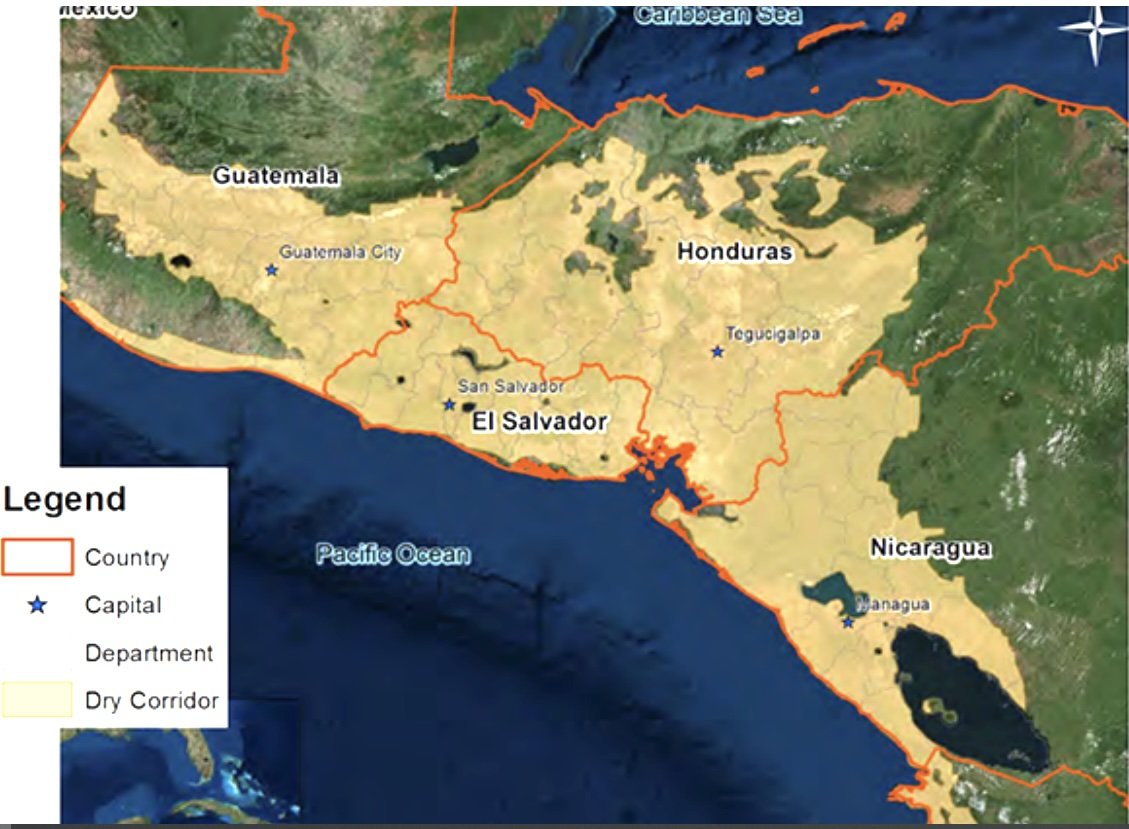
Screenshot: Expanding dry corridor through Central America
Map credit: Santa Clara University
Guaranteeing supply chains to wealthier countries and markets
The monopolized use of Honduras’ best lands, dating back to the “banana republics” in the 1800s, helps ensure a regular supply of desired food products to consumers in wealthier countries while being the primary cause of repetitive, inter-generational patterns of poverty and famine characterizing the lives of a significant percentage of the Honduran population.
Political interventions
Keeping all this in place, the U.S.-led West have regularly intervened –invading or supporting military coups- to keep in place, or put back in place governments that prioritize the market demands of the global economic order.
"Our privileges are located on the same map as their suffering, and may - in ways that we prefer not to imagine - be linked to their suffering. As the wealth of some may imply the destitution of others."
Susan Sontag
“The history of the underdevelopment of Latin America makes up the history of the development of world capitalism. Our defeat was always implicit in another’s victory; our wealth has always generated our poverty, in order to feed the prosperity of others.”
Eduardo Galeano
"Like slavery and apartheid, poverty is not natural. It is human made, and it can be overcome and eradicated by the actions of human beings.”
Nelson Mandela
“You cannot have untold, obscene wealth unless you have untold, obscene poverty. That is the law of capitalism.”
Keeanga-Yamahtta Taylor
More than 2 million Hondurans facing hunger
By Viena Hernández, August 10, 2026
https://criterio.hn/advierten-que-mas-de-2-millones-de-hondurenos-enfrentarian-crisis-alimentaria-al-finalizar-2026/
The food insecurity situation currently affecting 1.8 million people in Honduras could worsen by the end of 2026, with 2.2 million people severely affected, due to the lack of preventive policies by the government to prevent food shortages and precarious living conditions.
Tegucigalpa, Honduras – The precarious situation caused by food shortages for the population suffering from a lack of preparedness for droughts, especially those living in the Dry Corridor, is worsening daily. Around 1.8 million people currently suffer from food insecurity in Honduras, but the situation could worsen by the end of 2026, with 2.2 million people severely affected.
That is the figure warned by the Food and Nutritional Security Observatory (Obsan ) of the National Autonomous University of Honduras (UNAH), according to a report recently presented. This grim scenario is the product of multiple factors such as the severe droughts that are hitting crop production in the country due to the El Niño phenomenon, as well as the increase in the price of basic goods and the high cost of fuels and fertilizers.
Since March 2026, those 1.8 million people, from 10 of the country's 18 departments, have been immersed in prolonged food insecurity and have now entered a food emergency, the food security observatory study recorded.
In a conversation with Criterio.hn, the coordinator of the UNAH's Obsan, María Luisa Matamoros, pointed out that the local government and municipalities are focusing their strategy solely on addressing the food security emergency of the affected population. The public policies within the Food and Nutritional Security Law are too broad to act upon, so it was recommended to review the strategies it contains, as they could have prevented reaching the current level of food and nutritional insecurity.
The emergency encompasses 75 municipalities located along the dry corridor, which are currently under a yellow alert issued by the Permanent Contingency Committee (COPECO). However, actions are only active and immediate during the emergency, as they are projects, for example, to deliver non-perishable food to people in the affected areas.
“These strategies won’t necessarily reduce the 1.8 million people currently in need, but these immediate actions being taken might not lead to an increase like the projection we at Obsan have been making, which is that the number will reach 2.2 million by the end of this year. However, reducing the number of people experiencing food and nutritional insecurity depends on more structured decisions and strategies,” explained María Luisa Matamoros.
Achieving results requires sustained decisions, from implementing irrigation systems for small and medium-farming communities to strengthening agriculture with low-interest or accessible loans and other structured strategies. It also involves engaging academia and organizations working on food insecurity.
Women, who are often the heads of households, should be empowered to contribute to the dynamism of local markets and to generate more employment opportunities, since the biggest problem leading to food insecurity is the lack of access to food and the economic income that households lack.
“With the declaration of a state of emergency for them (1.8 million people), as we've said, they are already facing a food emergency. They haven't been able to escape food insecurity; instead, their problem has worsened. Therefore, this population is unlikely to recover. Simply providing them with food right now, or improving road infrastructure, won't resolve their food insecurity, because these actions are only temporary solutions,” Matamoros lamented.
For this reason, the effects of the droughts and the aforementioned factors have intensified, because the government's actions are only aimed at combating the emergency, not at preventing or mitigating it in advance. Strategies at the governmental and structural levels must be well-conceived and implemented.
Furthermore, the report reveals some very interesting data, such as that an agricultural worker's income is L6,865 per month, which only covers the basic rural food basket for just three people. On the other hand, nine out of ten hectares of land depend exclusively on rainwater; in other words, agricultural policy doesn't compete with the market, but rather with the rainfall patterns.
Hunger and lack of response
According to the Integrated Food Security Phase Classification (IPC), 18% of the population has already been experiencing an acute or phase three food crisis since March 2026. Furthermore, it reveals that if the situation worsens and reaches 2.2 million people between August and October 2026, a severe escalation and deepening of the current crisis would occur, expanding the percentage of those affected from 18% to 22% of the country's total population.
Permanent crops occupy 762,801 hectares, almost double the area dedicated to staple grains (396,575 ha) used to feed families, but 80.1% of that volume is sugarcane. It is also worth noting that five departments in the country (El Paraíso, Francisco Morazán, Lempira, Choluteca, and Intibucá) account for 44.6% of staple grain production and coincide with the areas of greatest IFC severity, revealing that production does not equate to food security.
The current crisis cannot be hidden. Among the municipal authorities who have denounced and demanded a response is the mayor of San Antonio de Flores, El Paraíso, Pedro Cáceres Funes, who told local media that some three thousand residents are going hungry in that area due to a lack of access to food, the high cost of the basic food basket, and the lack of employment opportunities.
“Three thousand people in my municipality are hungry. Traditionally, Hondurans only act when they are desperate. For me, this is a hunger pandemic, and traditionally, aid arrives when people don't need it or when people have already died,” Cáceres lamented.
For his part, César Núñez Lagos, mayor of San Antonio de Flores, Choluteca, has stated that if there is no rain in August and the remaining months of the year, the food crisis will worsen and many people will be forced to leave the area.
Adding to this complaint is Teófilo Oyuela, a local agricultural and livestock producer, who reported with concern that 80% of the population of San Antonio de Flores lives off livestock and agriculture, but the lack of water prevents the development of businesses and the generation of products to sell in the market, which has caused the farms to no longer be able to sustain themselves or help other families in the towns and villages.
“There are days when we don’t eat. In my case, I supply fresh snacks to 14 schools, and they’ve told me not to bring them any ingredients to make drinks because there’s no water and no money for sugar either. Without work, the crime rate is going to rise. We ask the government to help us, to make it easier for us to create jobs. We need irrigation systems for those who have plots of land along the riverbank, because by cultivating them, we’ll be able to create jobs again,” Oyuela said.
Meanwhile, Juan José Reyes, head of Early Warning at COPECO (the Honduran Permanent Contingency Commission), announced that 75 municipalities remain under yellow alert and have assessed the impact of the drought on livelihoods. He indicated that this analysis will determine the best course of action to minimize the drought's impact, particularly on food security.
“For the moment, we have managed to control food insecurity. There was a harvest from last year (2025), and that is what is being consumed. We don't rule out an impact on food security, but we must conduct assessments through the Ministry of Health. Just because a situation exists doesn't mean we are going to determine that there is food insecurity,” said Juan José Reyes, despite the precarious condition of the aforementioned populations.
Honduras' Dry Corridor on the brink of famine
By Viena Hernández, CriterioNews, September 7, 2026
Find here in Spanish (https://criterio.hn/corredor-seco-de-honduras-a-la-puertas-de-una-hambruna/) an extensive report on how a severe drought triggered by the "Super Niño" phenomenon and environmental damage from mining and sand extraction has pushed Honduras’s Dry Corridor to the brink of famine.
The lack of rain since June 2026 has dried up rivers, killed livestock, and destroyed essential crops like corn and beans across southern municipalities in Francisco Morazán, Valle, and Choluteca. Although the government declared a red alert in 103 municipalities and allocated over 304 million lempiras for emergency relief, residents and local officials report that food aid and water infrastructure have not arrived. Facing soaring food and water prices alongside a lack of local jobs, impoverished farmers are struggling to survive and fear complete starvation if rains do not return before the mid-September planting deadline.