
Exhumation of mass grave at El Cabro military base
FAMDEGUA & Guatemalans refuse to give up search for the disappeared
April 6, 2026, by Rights Action (information from FAMDEGUA)
Survivors and family members of victims of the U.S. and Western-backed genocides and State repression against Guatemalan civil society in the 1970s and 1980s push forward, 40 years later, exhuming mass graves, telling the truth, and fighting (despite enormous obstacles of systemic corruption and impunity) for justice.
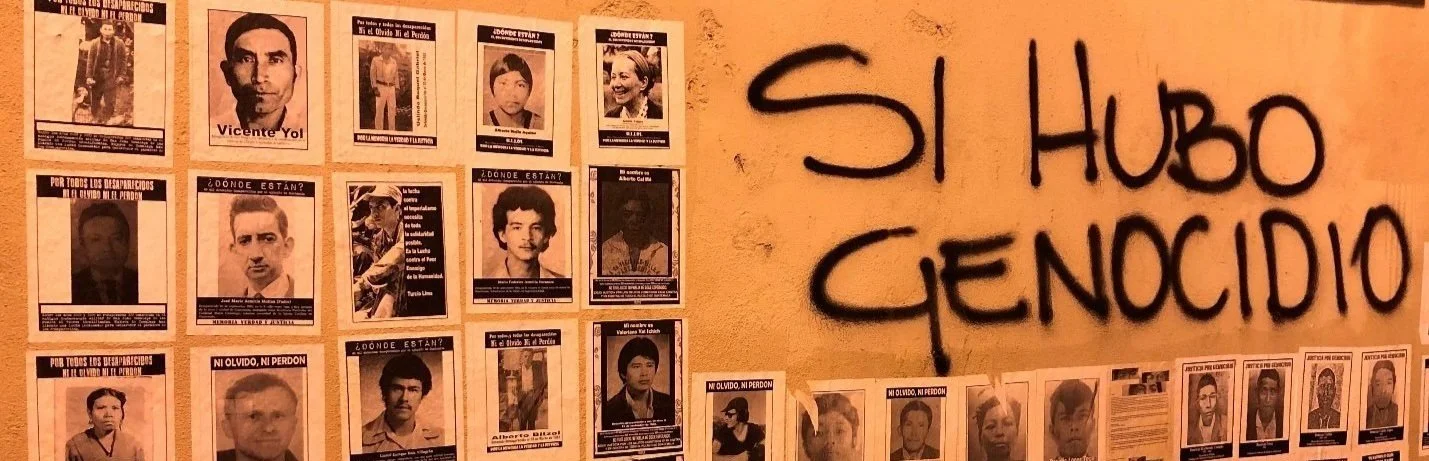
“Yes, it was genocide in Guatemala”
Supported by FAMDEGUA (Association of Family Members of the Disappeared in Guatemala) and other grassroots groups, Guatemalans push forward with this heart-wrenching, courageous work even as the U.S., Canadian and Western European-backed genocide continues in Palestine, as the U.S. and Israel reign death and destruction across Iran, Lebanon and beyond, as the U.S. (supported openly or quietly by Canada and key Western allies) harmfully and violently intervened in Honduras and Venezuela, while strangling the economy of Cuba.
This is our global human, Nation-State order.
These are our times.
El Cabro exhumation
In December 2025, exhumations began at the former El Cabro military outpost in the municipality of Dolores, Petén. The exhumation of mass graves across Guatemala began in 1991, and is the fundamental part of truth and justice efforts aimed at shedding light on, and seeking justice for the mass killings and disappearances that occurred during the worst years (1975-1985) of State repression, including genocides in four Mayan regions of the country.

“Historic memory”
Decades of these military regimes in Guatemala were armed, financed, trained, and legitimized by the U.S., and, at different times, by U.S. allies such as England, Germany, France, and Israel, as well as the military regimes in power at that time in Chile and Argentina.
To date, 11 victims have been dug up in El Cabro: seven minors and four women. Specialized teams continue to work at the site, where more human remains are believed to exist.
The procedure combines archaeological techniques, anthropological analysis, and scientific protocols that seek to ensure a dignified identification of the remains, while protecting the chain of custody, as each exhumation is part of a criminal investigation.

Clyde Snow was a driving force behind the establishment of the first “exhumation” team, the EAFG (equipo de antropologia forense de Guatemala) that, years later, became the FAFG (Guatemalan foundation of forensic anthropology).
Former military installations across Guatemala have been identified by survivors and human rights organizations as key centers of kidnapping, torture and forced disappearance of thousands of civilians during these worst years of Western-backed violence.
Each exhumation and investigation in these spaces of crimes against humanity represents a vital part of truth telling for surviving family members and of telling the true history of Guatemala.
For family members, the El Cabro exhumation represents hope.
It is not just about recovering skeletal remains. Each identification allows the “disappeared” person to be transformed into a recognized person, with identity and memory; it allows for a dignified burial finally; and it may contribute to justice processes going forward – as daunting as those are in these times.
FAMDEGUA
Rights Action is proud to continue send grassroots funding to FAMDEGUA, that is now supporting family and community members at the mass grave exhumation in the former military base “El Cabro”.
Since 1992, FAMDEGUA and other grassroots groups have been at the forefront of the fight for truth, justice, and historical memory in a country that still has not fundamentally recovered from the years of Western-backed atrocities, where ‘genocide denial’ by the traditional elites sectors is very pronounced today.
Born out of the loss and suffering of mothers, fathers, sons and daughters of people kidnapped and disappeared during the worst years of State repression and the genocides, FAMDEGUA continues to work to transform individual loss and grief into a collective cause that, more than three decades later, continues to challenge the State and society.
An open wound, amid fear and silence
The organization was born amid silence and fear. Many families saw their loved ones kidnapped by State security forces and never returned. Their absence, without bodies or official explanation, became an open wound that cut across entire communities.
Faced with government and State denial, corruption and impunity, and sometimes plain old indifference, FAMDEGUA took on the task of seeking answers, documenting cases, and demanding justice.
Work sustained by memory, truth, and justice
Since its founding, FAMDEGUA has worked tirelessly to search for missing persons, coordinating efforts with other human rights organizations, forensic teams, and anthropology experts. Collecting testimonies, rigorously documenting cases, and supporting families have been fundamental pillars in pushing forward investigations and legal proceedings at both the national and international levels.
Support for exhumations
One of the central pillars of FAMDEGUA's work has been to promote and support exhumation processes in clandestine graves throughout the country, including in former military detachments. In coordination with forensic experts, the organization has contributed to the recovery of skeletal remains, allowing those who were reduced to anonymity to be given back their identity.
Emblematic crimes against humanity cases
Among the emblematic crimes against humanity legal cases accompanied by FAMDEGUA are the Las Dos Erres massacre, the Diario Militar case, the Los Josefinos massacre, proceedings related to exhumations in the former military zone of Cobán (CREOMPAZ), the case of the forced disappearance of Luz Leticia Hernández Agustín, and the case of Efraín Bámaca Velásquez, among others.
These cases have helped to expose State and government responsibilities, even as all these cases have been confronted by on-going, deeply entrenched corruption and impunity in the legal system, much of the media and the traditional elite sectors of Guatemala, known as the “pact of the corrupt”.
Search in the east of the country
In Camotán, Chiquimula, recent findings from exhumations also seek to shed light on human rights violations committed in the east of the country. These processes, driven by the search for truth and justice, aim to bring closure to families who have been grieving for decades.
Experts emphasize that these types of interventions are part of the justice mechanisms aimed at clarifying serious human rights violations and dignifying victims. In a country where possibly hundreds of thousands of people remain missing, each exhumation is an act of remembrance and a continuing demand for justice.
Women at the forefront of resistance
Women have played a decisive role within FAMDEGUA. Mothers, daughters, and grandmothers have led marches, commemorative events, public denunciations, and organizational processes. Their persistence has kept memories alive in contexts where forgetting seemed almost forcibly imposed by the relentless denials of the traditional elites.
With photographs pinned to their chests and names spoken aloud, these women have turned resistance into a form of love and dignity. Their leadership has allowed the cause to transcend generations and the search to continue even when the passing of time seeks to dilute responsibilities.
Continuing challenges
More than thirty years after its founding, FAMDEGUA continues to remind the country that memory cannot be covered up and archived, and that the memories of the massacre victims and forced disappearances do not expire in the collective consciousness. As long as there are those who name the disappeared and demand justice, their history will not be erased.
Rights Action archives
More information
FAMDEGUA, Asociación Familiares de Detenidos-Desaparecidos de Guatemala, famdegua@gmail.com, https://www.facebook.com/FAMDEGUAG/, https://twitter.com/FamdeguaG
Verdad y Justicia en Guatemala, https://www.facebook.com/VerdadJusticiaG, https://twitter.com/VerdadJusticiaG/
PLATAFORMA CANADA-Guatemaltecos Exiliados por Terrorismo de Estado, https://www.facebook.com/GuatemaltecosExiliadosCanada, https://www.instagram.com/plataforma_canada/
NISGUA (Network in Solidarity with People of Guatemala): www.nisgua.org, https://twitter.com/NISGUA_Guate, https://www.facebook.com/NISGUA.Guate
GHRC (Guatemalan Human Rights Commission): www.ghrc-usa.org, https://twitter.com/GHRCUSA
Breaking the Silence: www.breakingthesilenceblog.com, https://twitter.com/BTS_MG, https://www.facebook.com/BTSGuateMaritimes
Rights Action (U.S. & Canada)
Since 1995, Rights Action funds land, justice, human rights and democracy struggles, environment, community development and emergency relief projects in Guatemala and Honduras. Rights Action works to denounce and hold accountable the U.S. and Canadian governments, global companies, investors and banks (World Bank, etc.) that help cause and profit from exploitation and poverty, repression and human rights violations, environmental harms, corruption and impunity in Honduras and Guatemala.